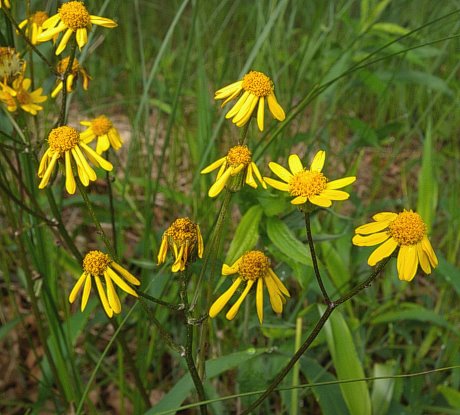
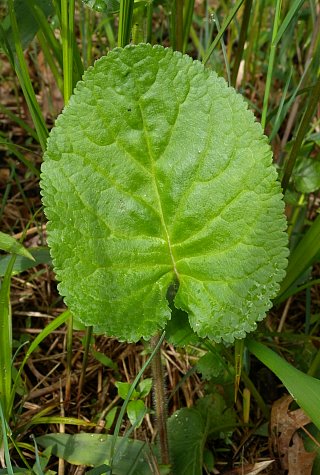
Description: This perennial wildflower is ½–2' tall. At the base of each plant, there is a small rosette of basal leaves spanning about 6-8" across. The blades of the basal leaves are typically 2-3" long and 2" across; they are cordate-orbicular to cordate-oval in shape, crenate-dentate along their margins, and hairless. The slender petioles of the basal leaves are as long as the blades. A flowering stalk develops from the center of each rosette. Along this stalk, there are usually 2-3 alternate leaves. The alternate leaves are smaller in size than the basal leaves and pinnatifid in shape. Both the alternate leaves and the stalk are hairless during the blooming period and thereafter. The stalk terminates in a flat-headed panicle (or corymb) of flowerheads. The branches of this panicle are slender and hairless. Each daisy-like flowerhead is ½–¾" across; in the center there are numerous golden yellow disk florets, which are surrounded by 6-16 yellow ray florets. Both the disk and ray florets are fertile. Surrounding the base of the flowerhead, there are numerous linear green bracts in a single series. The blooming period occurs from mid- to late spring and lasts about 3 weeks. Each floret is replaced by a bullet-shaped achene with a small tuft of white hairs. The achenes are distributed by the wind. The short rootstock has spreading fibrous roots and it produces rhizomes (or stolons). Vegetative colonies of plants are often produced in favorable habitats.
Cultivation:
The
preference is full sun to light shade, wet to mesic conditions, and
soil with abundant organic matter to retain moisture. Plants that grow
in sunlight require more moisture than plants growing in shade.
Range & Habitat:
Golden Ragwort is occasional throughout Illinois (see Distribution
Map), where it is native.
Habitats include wet to mesic deciduous woodlands, damp woodland
openings, woodland borders, moist sandy savannas, sandy swamps, seeps
and edges of springs, banks of rivers and lakes, slopes of rocky
ravines, glades, moist meadows, roadside embankments, and abandoned
fields. Golden Ragwort is more shade-tolerant than many other ragworts (Packera
spp.) in the state.
Faunal Associations:
The nectar and pollen of the flowers attract small bees and flies
primarily. Among the bees, are such visitors as little carpenter bees (Ceratina spp.),
cuckoo bees (Nomada spp.), and various Halictid
bees. Among the flies, are such visitors as Syrphid flies, Tachinid
flies, and miscellaneous others. The caterpillars of a moth, Orthonama
obstipata (The Gem), feed on ragworts (Packera spp.).
The foliage is shunned by most mammalian herbivores because
of its toxicity, although sheep are more tolerant and will eat it.
Photographic
Location:
An opening in a sandy swamp at the Irwin Prairie State Nature Preserve
in NW Ohio.
Comments:
Goldenrod Ragwort (Packera
aurea) is an attractive spring wildflower. In Illinois,
the
perennial Packera spp. (Ragworts) differ from each
other by the shape of their basal leaves. Among these, Golden Ragwort
has the most orbicular basal leaves; each basal blade is slightly to
strongly indented at the base where it is joined by the petiole. Other
perennial Ragworts have more slender basal leaves that are usually oval
to elliptic in shape. One of them, Packera plattensis
(Prairie Ragwort), has conspicuous hairs on its leaves and stems, while
mature plants of Golden Ragwort are hairless. A scientific synonym of
Golden Ragwort is Senecio aureus, and it is
sometimes referred to as 'Heart-Leaved Ragwort' or 'Heart-Leaved
Groundsel.'