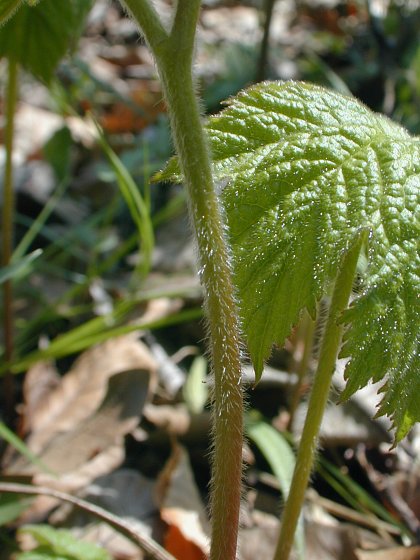
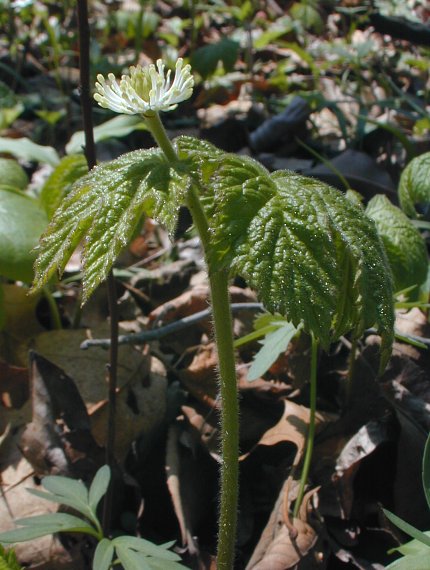
Description: This herbaceous perennial plant is about ¾-1' tall and unbranched. A typical plant produces a single basal leaf on a long hairy petiole and a flowering stalk with a pair of cauline leaves near its apex. However, not all plants produce flowers. The central stalk is light green to reddish green, terete, rather stout, and quite hairy. One cauline leaf is sessile, while the other cauline leaf has a short petiole up to 2" long. The petioles of the basal and cauline leaves have characteristics that are similar to the flowering stalk. The basal leaves are up to 10" long and 10" across, while the cauline leaves are up to 8" long and 8" across. Both types of leaves have about 5 palmate lobes and their margins are doubly serrated and shallowly cleft. During the blooming period, these leaves are wrinkled, hairy, and smaller in size, but later in the year they become more smooth, less hairy (or even glabrous), and full-sized. The color of the leaves may change from yellowish green during the spring to medium-dark green during the summer.
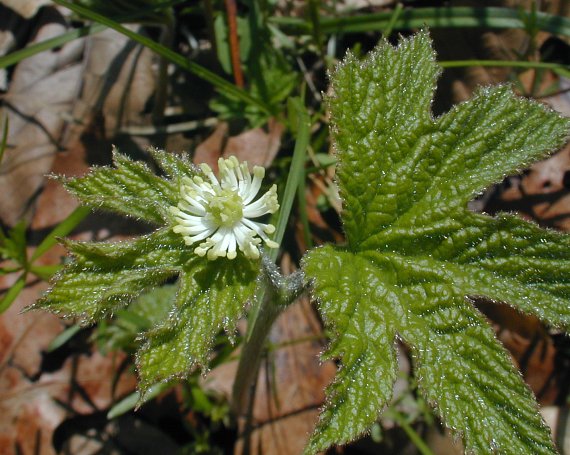
A flowering plant produces a single terminal flower on a short pedicel (up to 2" long); this pedicel is similar to the central stem in its characteristics. The flower is about ¾" across, consisting of 3 deciduous sepals, no petals, approximately 40 spreading stamens, and approximately 10 clustered pistils in the center. The greenish white sepals drop early and they are not present while the flower is in bloom. The stamens have white filaments and yellow or greenish yellow anthers. The slightly flattened pistils have short beaks and they are initially pale green. The blooming period occurs from mid- to late spring and lasts about 2-3 weeks. By mid- to late summer, the pistils have been replaced by a small tight cluster of bright red berries. Each berry contains 1-2 black shiny seeds. The root system consists of knotty yellow rhizomes and fibrous roots. This plant reproduces by clonal offsets from its rhizomes and by seed. It occasionally forms small colonies.
Cultivation:
This
plant prefers dappled sunlight during the spring and light to moderate
shade during
the summer. It prefers moist to mesic conditions and a fertile loamy
soil with an
abundance of leaf mould. Wild plants are little bothered by disease,
although stressed out cultivated plants can be attacked by leaf blight
and other diseases. Slugs eat seedlings and the foliage
of mature plants, while root knot nematodes occasionally attack the
root system. Starting plants from seeds is slow, while vegetative
propagation from rhizomes is easier and faster.
Range & Habitat:
The native Goldenseal occurs occasionally in scattered counties
throughout Illinois (see Distribution
Map), although populations have
been declining because of habitat destruction and over-collection of
the rhizomes. Habitats include moist to mesic deciduous woodlands,
wooded bluffs, and areas along woodland paths. A limited amount of
disturbance is beneficial when it reduces excessive shade from the
overhead canopy.
Faunal
Associations:
The flowers are cross-pollinated by small Halictid bees (Lasioglossum
spp.) and masked bees (Hylaeus
spp.) primarily; they
are also visited by Syrphid flies and larger bees (Sinclair et al.,
2000).
Presumably birds or small mammals eat the berries and help to
distribute the seeds, but little specific information is available
about this. Little is known about the attractiveness of the foliage as
a food source to
mammalian herbivores, although it is probably toxic to them like most
members of the Buttercup family.
Photographic Location:
A deciduous woodland in Vermilion County, Illinois.
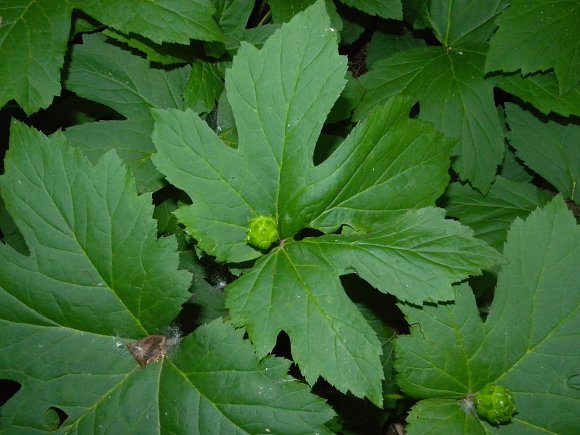
Comments: Goldenseal has a unique appearance because of the wrinkled palmate foliage (while young), unusual petal-less flowers, and beaked red fruits. As a result, it is easy to identity at either the flowering or fruiting stage. The biggest threat to this species is over-collection of the rhizomes for herbal medicine; these rhizomes can sell for $100/lb. on the wholesale market. They contain the alkaloids hydrastine, berberine, and canadine. Hydrastine is used for feminine complaints, berberine has anti-bacterial and anti-protozoan properties, and canadine is a sedative and muscle relaxant. Under the CITES convention, it is illegal to export the rhizomes and other parts of rare wild-collected plants in the United States. The common name of this plant refers to the yellow rhizomes.