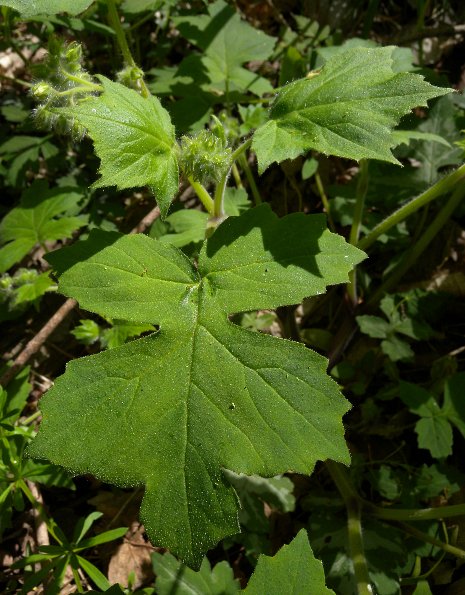
Description: This biennial plant is about 1–2½' tall, branching occasionally. The stems have a tendency to zigzag between leaves; they are light green, terete, and both short-pubescent and hairy. The alternate leaves are up to 6" long and 6" across. The lower leaves are pinnately cleft into 5 lobes; they are longer than wide, dentate along their margins, and slightly hairy. The earliest of these lower leaves have patches of greyish white or light green toward the middle of their upper surfaces, providing them with a water-stained appearance. The middle to upper leaves are orbicular and cleft into 5 lobes, resembling maple leaves; they are dentate along their margins and slightly hairy. The petioles of these leaves are rather long and stout; they are both short-pubescent and sparsely hairy.
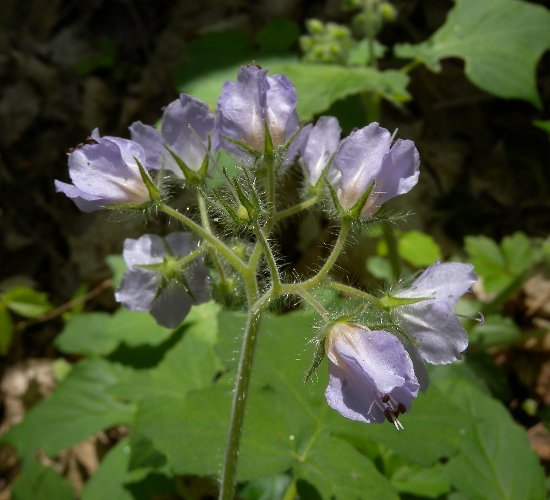
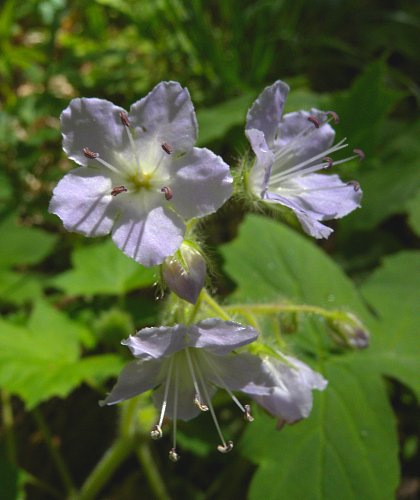
The upper stems terminate in floppy cymes of flowers. These flowers are about ¾" across when they are fully open, becoming more erect while in bloom. Each flower has a lavender or pale purplish pink corolla that consists of 5 spreading petals. At the base of this corolla, there is a hairy green calyx with 5 narrowly triangular teeth. Between each pair of teeth on the calyx, there is a short appendage that is strongly recurved. Toward the center of the corolla, there are 5 stamens with light to medium brown anthers and a slender white style that is divided toward its apex. The peduncles and pedicels of the cymes are light green, terete, and both short-pubescent and hairy; the peduncles are up to 6" long, while the pedicels are up to 1" long. The blooming period occurs from late spring to early summer, lasting about 3 weeks. Each flower is replaced by a 2-chambered capsule containing several seeds. The root system consists of a taproot. This plant spreads by reseeding itself.
Cultivation:
The
preference is light dappled shade, moist to mesic conditions, and a
rich loamy soil containing abundant organic matter. Sometimes this
plant succumbs to fusarium wilt and other wilt-causing fungi. In spite
of its biennial habit, it is possible to maintain this plant in a
woodland flower garden as it reseeds itself readily.
Range & Habitat:
The native Great Waterleaf occurs occasionally in central and northern
Illinois;
it is less common or absent in the southern and extreme NW areas of the
state (see Distribution
Map). Habitats include moist to mesic deciduous woodlands,
woodland borders, areas adjacent to woodland paths, shaded or partially
shaded seeps, and shaded or partially shaded areas along rivers. This
woodland wildflower begins to bloom after the leaves of the trees have
partially developed.
Faunal
Associations:
The nectar and pollen of the flowers attract various kinds of bees,
including honeybees, bumblebees, mason bees (Hoplitis spp., Osmia spp.), digger
bees (Synhalonia spp.),
Andrenid bees (Andrena
spp.),
and Halictid bees (Lasioglossum
spp., etc.). An Andrenid bee, Andrena geranii, is
a specialist pollinator (oligolege) of Hydrophyllum
spp. Other insects that visit the flowers include Syrphid
flies, dance flies (Empis
spp.), butterflies, and skippers. Except for these flower
visitors, surprisingly
little appears to be known about floral-fauna relationships for this
species. White-Tailed Deer probably browse on the foliage.
Photographic Location:
A woodland flower garden on the campus of the University of Illinois in
Urbana, Illinois, and a deciduous woodland at Pine Hills State Nature
Preserve in west-central Indiana.
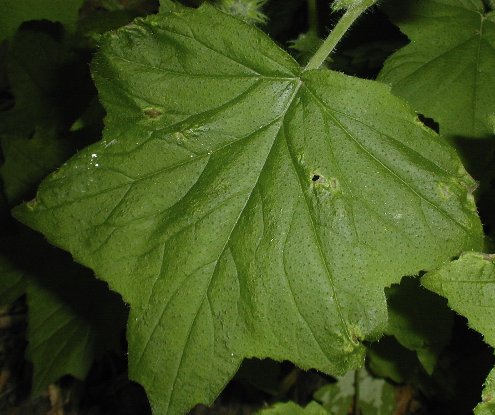
Comments: Great Waterleaf (Hydrophyllum appendiculatum) is one of the more common Hydrophyllum spp. within the state and its flowers are the most attractive. This species has hairy stems and calyxes, and some of its leaves resemble maple leaves. A distinctive characteristic consists of the small recurved appendages between the teeth of its calyx, hence the "appendiculatum" in the scientific name. Other Hydrophyllum spp. lack these strongly recurved appendages and they have less showy flowers. Virginia Waterleaf (Hydrophyllum virginiana) and Canada Waterleaf (Hydrophyllum canadense) have less hairy stems, while Large-Leaved Waterleaf (Hydrophyllum macrophyllum) lacks cleft orbicular leaves that resemble maple leaves. The leaves of this latter species are always longer than broad, and they are pinnately divided to an even greater extent than the lower leaves of Great Waterleaf.