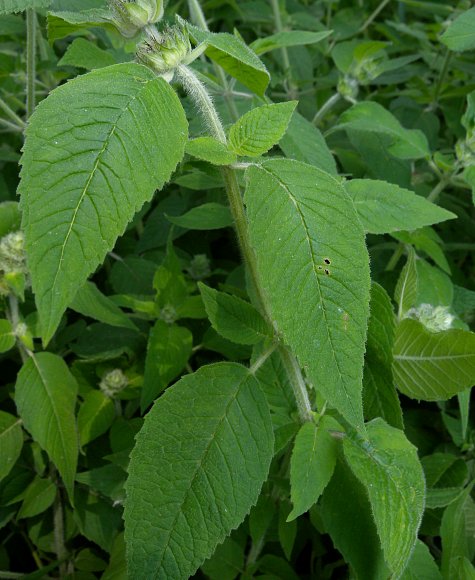
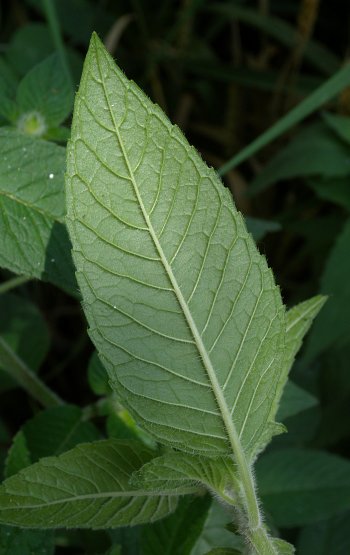
Description: This perennial plant is 1-3' tall and unbranched or sparingly branched. The central stem is light to dark green, 4-angled, and covered with long white hairs. The opposite leaves are up to 3½" long and 1½" across. They are ovate or lanceolate-ovate in shape, serrated along their margins, and often ciliate. The lower surface of each leaf is light to medium green and densely pubescent to nearly glabrous; in the latter case, there are scattered hairs along the central and some of the lateral veins. The upper leaf surface is medium to dark green; it has either scattered appressed hairs or it is glabrous. The petioles are about ½-1¼" long and covered with spreading hairs. Small secondary leaves often develop from the axils of the leaves on the central stem.
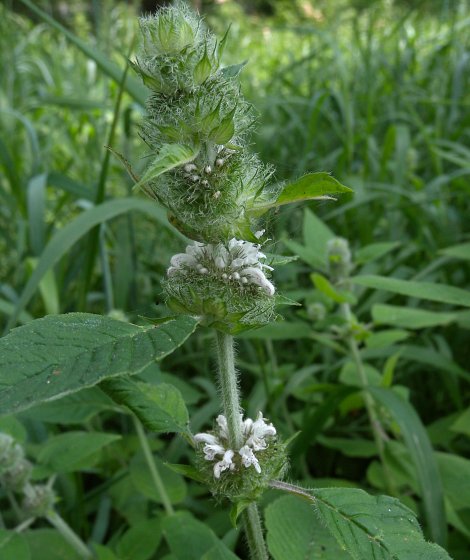
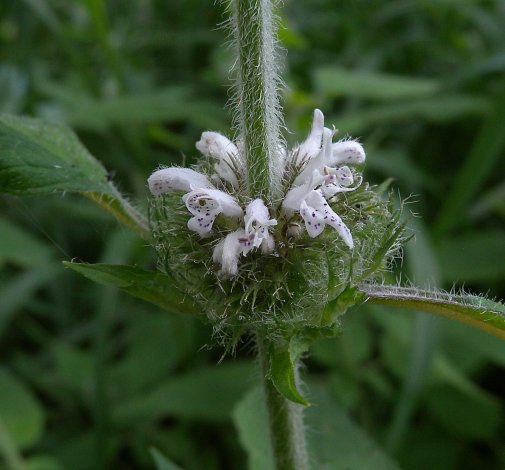
The central stem (and any major side stems) terminates in several whorls of flowers. The whorls of flowers occur above the axils of the upper leaves, or they may occur above pairs of leafy bracts that are sometimes inconspicuous. The flowers in each whorl are densely crowded together. Each flower is up to ½" long, consisting of a short-tubular calyx with 5 teeth, a 2-lipped corolla, 2 exerted stamens, and a slender style that is divided at its tip. The calyx is light green and exceedingly hairy along the margins of its teeth; the upper teeth are longer than the lower teeth. The corolla is light purple or white and it has purple dots on the lower lip; the outer surface of this corolla is finely pubescent on the upper side. The lower lip is divided into 3 lobes, while the upper lip functions as a protective hood. The blooming period occurs during the summer and lasts about 1-1½ months. Each flower is replaced by 4 ovoid nutlets. The root system is fibrous and rhizomatous. Clonal colonies of plants often develop from the rhizomes.
Cultivation:
The preference is partial sun to light shade, moist to mesic
conditions, and a rich loamy soil with decaying leaf mold. This
species also grows in soil that is somewhat rocky.
Range & Habitat:
The native Hairy Wood Mint occurs occasionally throughout Illinois (see
Distribution
Map). Habitats include mesic deciduous woodlands, areas along
woodland paths, woodland borders, woodland openings, limestone glades,
and thickets. Minor
disturbance is desirable if it removes excessive shade from the
overhead canopy.
Faunal Associations: The flowers are pollinated primarily by long-tongued bees, including honeybees, bumblebees, little carpenter bees (Ceratina spp.), mason bees (Osmia spp.), leaf-cutting bees (Megachile spp.), cuckoo bees (Epeolus spp.), long-horned bees (Melissodes spp.), and Anthophorid bees (Anthophora spp.). Other visitors of the flowers include Halictid bees, wasps, bee flies (Bombyliidae), thick-headed flies (Conopidae), Syrphid flies, butterflies, and skippers. These insects seek nectar primarily, although some of the Halictid bees collect pollen and some flies feed on the pollen. There are few records of insects feeding destructively on Hairy Wood Mint, although a polyphagous aphid, Aphis coreopsidis, uses this plant as a summer host. The foliage probably isn't attractive to mammalian herbivores as a food source.
Photographic
Location:
Along a woodland path at Busey Woods in Urbana, Illinois.
Comments:
This is another member of the Mint family with pairs of opposite leaves
and relatively small tubular flowers. Hairy Wood Mint (Blephilia hirsuta)
has unusually hairy stems and
the dense hairy whorls of flowers are rather conspicuous. These dense
whorls of flowers distinguish the genus Blephilia
from many other members of the Mint family. The only other member of
this genus that occurs in Illinois is Downy Wood Mint (Blephilia
ciliata). Downy Wood Mint has leaves that are sessile or they
have
short petioles (less than ½"), and its stems are short-pubescent to
pubescent. Hairy
Wood Mint, on the other hand, has leaves with longer petioles and its
stems have spreading white hairs that are quite long. Downy Wood Mint
prefers habitats that are somewhat sunnier and drier; it is sometimes
found in prairies and savannas.