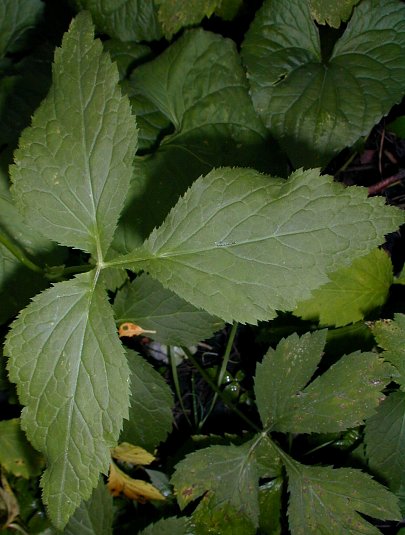
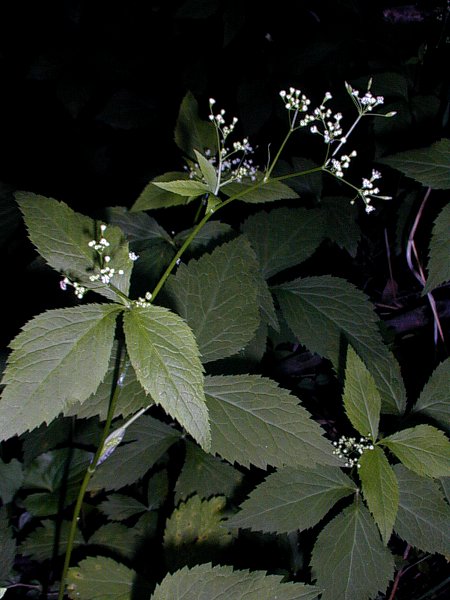
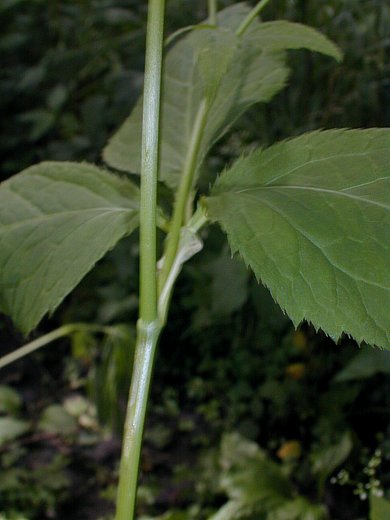
Description: This herbaceous perennial plant is 1-3' tall; it is unbranched toward the base, but branches occasionally in the upper half. The light green stems are glabrous and occasionally glaucous; they are slightly wider and angular at the bases of petioles. The compound leaves are trifoliate. The lower compound leaves have long petioles, while the upper compound leaves are sessile, or nearly so. Elongated membranous sheaths can be found at the bases of petioles. The leaflets of the compound leaves are up to 4" long and 2" across, becoming smaller as they ascend the stems. Individual leaflets are ovate, elliptic or lanceolate in shape, doubly serrated along their margins, and glabrous. Some of the lower leaflets may be shallowly to deeply cleft along their margins, forming 1-2 lobes. The leaflets are rounded or wedged-shaped at their bases, where they have winged petiolules (basal stalklets). The upper surface of leaflets is medium to dark green.
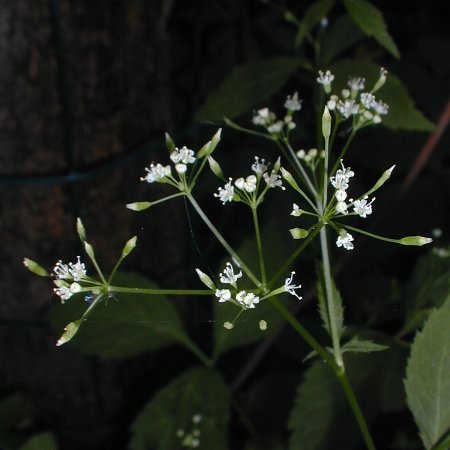
The upper stems terminate in compound umbels of tiny white flowers. These umbels are somewhat irregular and span about 1½-3" across. Each umbel divides into about 3-10 umbellets, while each umbellet consists of 3-10 flowers. Neither umbels nor umbellets have any significant floral bracts. Each flower is less than 3 mm. (1/8") across, consisting of 5 white petals, 5 white stamens, a conical pistil that is light green, and a short-tubular calyx that is green and without teeth. The petals usually curve inward at their tips. The blooming period occurs during early to mid-summer, lasts about 1 month. There is no noticeable floral scent. Each flower is replaced by an elongated ribbed fruit (schizocarp) that tapers at both ends. These fruits are initially green, but they later become dark-colored; each fruit consists of 2 seeds. The root system consists of a taproot. This plant spreads by reseeding itself; it occasionally forms colonies at favorable sites.
Cultivation:
The preference is medium to light shade, moist to mesic conditions, and
a loamy soil with decaying organic material.
Range & Habitat:
The native Honewort is a common plant that occurs in most areas of
Illinois (see Distribution
Map). Habitats include moist to mesic deciduous woodlands
(especially Sugar Maple & Basswood woodlands), woodland
borders, edges of shady seeps, wooded areas along springs and streams,
wooded bluffs, fence rows that are overgrown with trees, and shady
edges of yards. This species adapts well to shaded areas with a history
of light to moderate disturbance. It can also be found in higher
quality woodlands with more conservative species.
Faunal Associations: The nectar of the flowers attracts Halictid bees (Halictus spp., Lasioglossum spp., Sphecodes spp.), masked bees (Hylaeus spp.), Andrenid bees (Andrena spp.), cuckoo wasps (Hedychrum spp.), wild carrot wasps (Gasteruption spp.), Ichneumonid wasps, Syrphid flies, dance flies (Empis spp.), bee flies (Bombyliidae), thick-headed flies (Conopidae), Tachinid flies, Chloropid flies, long-horned beetles (Cerambycidae), leaf beetles (Chrysomelidae), tumbling flower beetles (Mordellidae), and other insects. Insect that feed destructively on Honewort include the leaf-mining larvae of Euleia heraclei (Hogweed Picture-Winged Fly), Cavariella aegopodii (Willow-Carrot Aphid), Hyadaphis foeniculi (Fennel Aphid), leaf-mining larvae of the moth Epermenia pimpinella, and caterpillars of the butterfly Papilio polyxenes asterius (Black Swallowtail). Information about this plant's relationships to vertebrate animals is scarce. White-Tailed Deer browse occasionally on the foliage. When colonies of plants develop, they provide cover for a variety of invertebrate and vertebrate animals.
Photographic
Location:
Busey Woods at Urbana, Illinois, where there are areas of moist to
mesic deciduous woodlands.
Comments:
Honewort is a woodland wildflower that blooms in the shade during the
summer. Its white flowers are quite small and not very showy, which is
quite typical of wildflower species that adapt to this type of habitat.
Because their are many members of the Carrot family with umbels of
small white flowers, they can be difficult to identify. Honewort can be
distinguished from similar species by the following characteristics: 1)
It has hairless leaves and stems, 2) it has trifoliate leaves with
leaflets that are sometimes cleft, 3) its leaflets are
elliptic to ovate, rather than narrowly linear, 4) its umbels of white
flowers are compound, rather than simple, and 5) it has no significant
floral bracts at the bases of either umbels or umbellets. If this isn't
sufficient to produce an identification (this is a difficult group of
plants), then consider the following two characteristics of the
leaflets: Theirs margin are usually doubly serrate, and the bases
of leaflets taper to winged petiolules (sometimes
they are quite short).