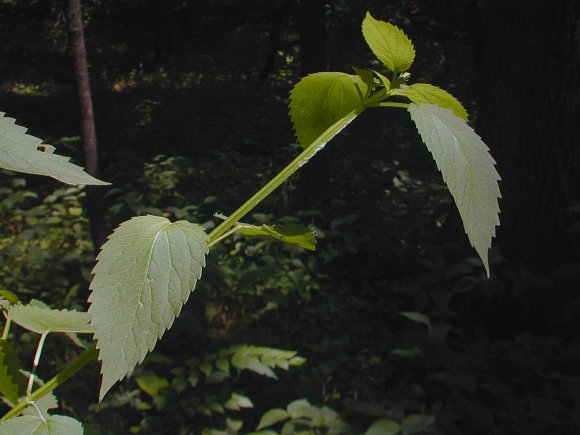
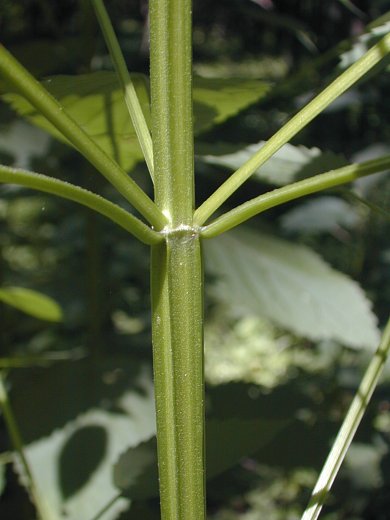
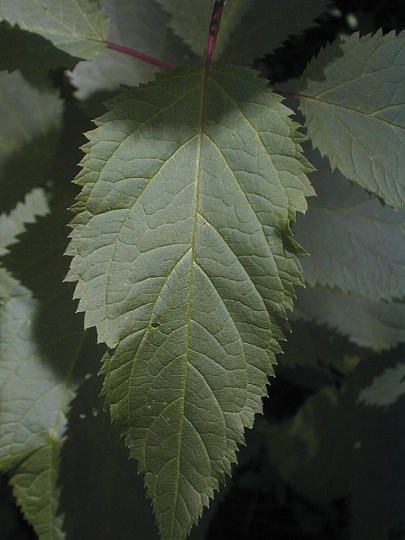
Description: This herbaceous perennial plant is about 3½-8' tall, branching occasionally. The stems are often 4-angled and furrowed; they are slightly hairy or glabrous. The opposite leaves are up to 7" long and 3½" across (excluding the petioles), becoming somewhat smaller as they ascend the stems. These leaves are medium to dark green, cordate-ovate to ovate in shape, serrated along their margins, thin-textured, and largely hairless, except for some short pubescence along the undersides of their veins. The slender petioles are up to 2½" long; they are light green to red and glabrous to slightly hairy. The upper stems terminate in elongated panicles of flowers up to 1' long. Each panicle is somewhat cylindrical in shape, consisting of an erect central stalk (rachis) with short lateral branches that are widely spreading to ascending. Both the central stalk and lateral branches are light green; the latter also have short glandular pubescence, and they are slender and wiry. There are individual bracts (green, linear in shape, and up to 1" in length) that become progressively smaller as the panicle branches.
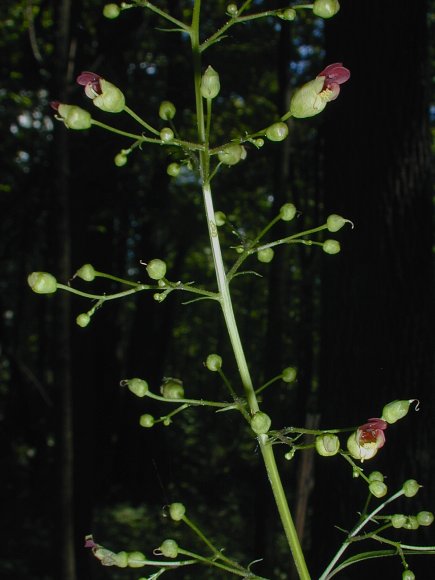
Individual flowers are about 8 mm. (1/3") long and short-cylindrical in shape; each flower has a short-tubular green calyx with 5 blunt teeth and a corolla with 5 rounded lobes. The exterior of the corolla is dull green, while its interior is predominantly reddish brown. Each corolla has a pair of upper lobes that function as a hood, 2 short lateral lobes, and a lower lobe that curves downward. All of these lobes are reddish brown on the inside, except the lower lobe, which is greenish yellow. Appressed against the upper interior of this corolla, there is an infertile stamen that is reddish brown or purple. The 4 fertile stamens have yellow anthers; they are located toward the bottom of the corolla. The slender pedicels are a little longer than the flowers. The blooming period occurs from mid-summer to early fall, lasting about a month; only a few flowers are in bloom at the same time. Each flower is replaced by a 2-celled capsule that contains numerous tiny seeds. The root system is rhizomatous and knotty-tuberous.
Cultivation:
The
preference is medium shade to partial sun, moist to mesic conditions,
and soil that is loose and loamy. The size of this plant can be
highly variable, depending on its age, location, and environmental
conditions.
Range & Habitat:
Late Figwort (Scrophularia marilandica) is a fairly common plant that
has been observed in most counties of Illinois (see Distribution
Map), where it is native. Habitats include mesic deciduous
woodlands, sandy woodlands, savannas, edges of shaded hillside seeps,
woodland borders, thickets, and fence rows that are overgrown with
trees. This species tolerates minor to moderate levels of disturbance.
Faunal Associations: The small flowers contain abundant nectar, which attracts the Ruby-throated Hummingbird, honeybees, bumblebees, leaf-cutting bees (Megachile spp.), a long-horned bee (Melissodes bimaculata), Halictid bees (Halictus spp., Lasioglossum spp., etc.), Vespid wasps (Polites spp., Vespula spp.), and various Eumenine wasps (Robertson, 1929). Halictid bees also collect pollen from the flowers. Insects that feed destructively on the leaves, plant juices, and other parts of Late Figwort and other figworts (Scrophularia spp.) include larvae of the gall fly Lestodiplosis scrophulariae, the stink bug Cosmopepla lintneriana, the aphid Myzus scrophulariae, the flea beetle Capraita thyamoides, and caterpillars of the moth Elaphria chalcedonia (Chalcedony Midget). Because the foliage is bitter and acrid, it is rarely browsed by mammalian herbivores.
Photographic
Location:
Busey Woods in Urbana, Illinois. A small colony of Late Figwort (Scrophularia marilandica)
was growing in a mesic area of this deciduous woodlands.
Comments:
The figworts (Scrophularia
spp.) have weird little flowers that attract many wasps
and bees. They are not grown in gardens very often because their
flowers are not very showy (by human standards). The only other figwort
that occurs in Illinois is Early Figwort (Scrophularia
lanceolata). This species is less common than Late Figwort (Scrophularia marilandica);
in Illinois, it is found only in the northern section of the
state. Early Figwort blooms a little earlier than Late Figwort
(hence their common names), although their respective blooming periods
overlap to some extent. The flowers of Early Figwort have sterile
stamens
that are yellow, rather than reddish brown or purple (the sterile
stamens of both species are located along the upper interior of their
corollas).