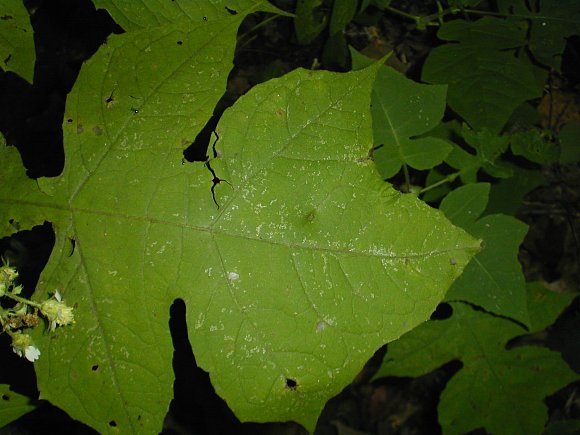
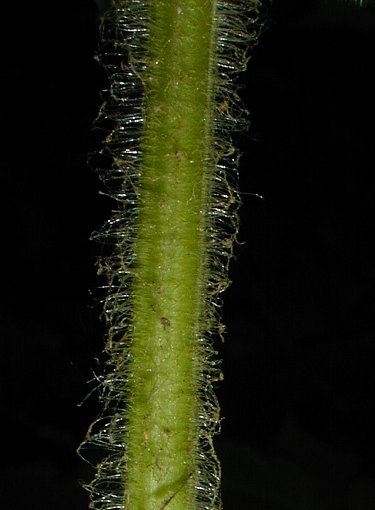
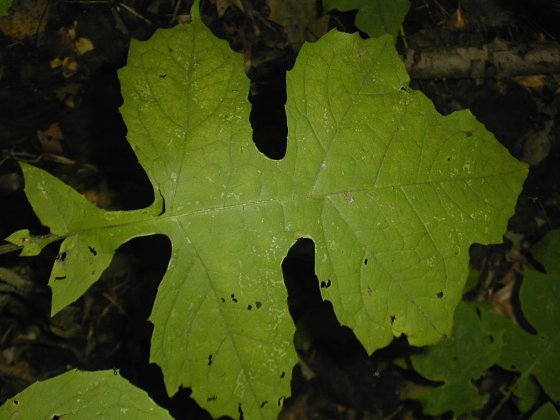
Description: This herbaceous plant is about 1½–4½' tall, branching occasionally. It is a biennial or short-lived perennial. The erect to ascending stems are light green to dull reddish brown, terete, and densely covered with long hairs. The alternate or opposite leaves are up to 12" long and 8" across, becoming gradually smaller as they ascend the stems. They have pubescent petioles up to 4" long that are grooved above and convex below. The lower to middle leaves are pinnately lobed and somewhat dentate or undulate along their margins; they usually have 5-7 major lobes with pointed tips. The upper leaves have pairs of basal lobes or they lack lobes; they are ovate, broadly hastate, or sometimes another shape.
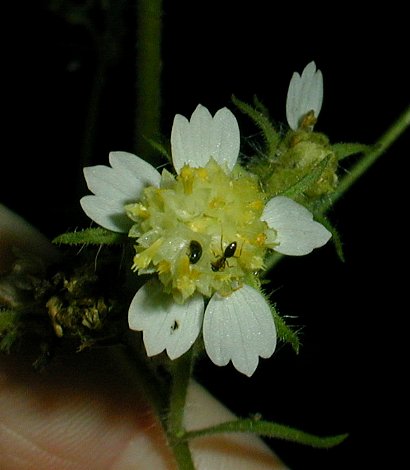
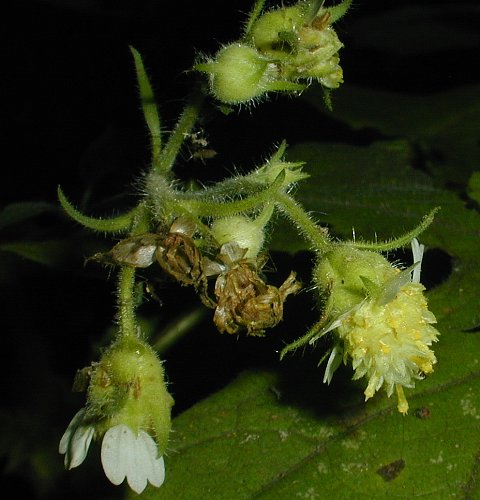
The upper leaf surface is dull medium green; it is usually hairless for older leaves and appressed-hairy for younger leaves. The lower leaf surface is pale green and pubescent primarily along the major veins. At the bases of petioles, there are pairs of large green stipules. These stipules are connate (merged together) and their margins are coarsely dentate. Small cymes of several flowerheads develop from the upper stems and the axils of upper leaves. The branches of these cymes are green and pubescent. Sometimes there are 1-2 small linear bracts where the branches diverge, and sometimes they are found underneath the flowerheads. These bracts are green, pubescent, and about 8 mm. (1/3") in length. Each flowerhead is about ½" across, consisting of several disk florets in the center and 5-8 ray florets around its circumference.
The small disk florets have cream-colored tubular corollas with 5 lobes; they are staminate. The petaloid rays of the flowerheads are white, obovate, short, and 3-lobed; sometimes they are absent. Only the ray florets produce achenes. Surrounding the base of each flowerhead, there are 5 floral bracts (phyllaries) that are light green, pubescent, and lanceolate in shape; they become recurved when the flowerheads bloom. The blooming period occurs from mid-summer into the fall, lasting about 2 months. Only a few flowerheads are in bloom at the same time. Somewhat later, the flowerheads turn brown and their ray florets are replaced by obovoid achenes that are 3-angled, dark brown, and 3-4 mm. in length. These achenes lack tufts of hair. The root system is fibrous, although a poorly developed taproot is sometimes present.
Cultivation:
This
species is typically found in light to medium shade, moist to slightly
dry conditions, and loamy to slightly rocky soil with abundant organic
matter. The size of individual plants is variable, depending on
moisture conditions and soil fertility. In the flower garden, this
species may be
short-lived.
Range & Habitat:
Leaf-Cup (Polymnia
canadensis)
is uncommon to occasional throughout Illinois (see Distribution
Map),
where it is native. Habitats include rich deciduous woodlands, upland
rocky woodlands, bases of bluffs, shaded moist ravines, wooded
slopes, shaded areas along streams, and edges of limestone or sandstone
glades. This wildflower is associated with oak-hickory, maple-linden,
and maple-beech woodlands; it is usually found in higher quality
woodlands where the original ground flora is still intact.
Faunal Associations: The nectar and pollen of the flowerheads attract honeybees, bumblebees, and miscellaneous flies (Sharp, 2002). Small bees probably visit the flowerheads in some areas as well. Ants feed on nectar from the disk florets of the flowerheads, but they are ineffective at cross-pollination (personal observation). Other insects suck plant juices or feed on the leaves of Leaf-Cup (Polymnia canadensis). These species include several plant bugs (Macrolophus spp., Dicyphus gracilentus, Plagiognathus albifascies), the aphids Uroleucon zinzalae and Capitophorus hippophaes, and the leaf beetle Sumitrosis inaequalis. The larvae of this latter species are leaf-miners. Several species in the Orthoptera feed destructively on the flowerheads (Gangwere, 1961); they include Neoxabea bipunctata (Two-spotted Tree Cricket), Oecanthus niveus (Narrow-winged Tree Cricket), Scudderia furcata (Fork-tailed Bush Katydid), and Anaxipha exigua (Say's Trig). The relationships of Leaf-Cup to vertebrate animals is currently unavailable.
Photographic
Location:
A deciduous woodland at the Portland Arch Conservation Area in
west-central Indiana.
Comments:
This woodland wildflower is a medium-large leafy plant. However,
Leaf-Cup isn't very well known among members of the public because its
small flowerheads are not very showy. These flowerheads are somewhat
similar in appearance to those of a weedy introduced plant, Galinsoga quadriradiata
(Peruvian Daisy). However, this latter species is a much smaller plant
of open areas. The closest relative of Leaf-Cup is Smallanthus
uvedalius
(Bear's Foot), which has larger yellow flowerheads and palmately lobed
leaves. This latter species can become up to 8' tall. In Illinois, it
is restricted to the southern part of the state.