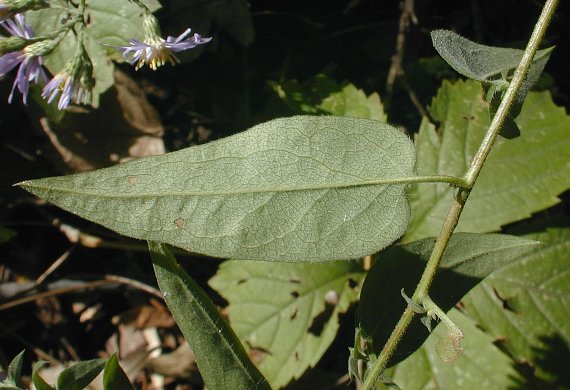
Description: This herbaceous perennial plant is 2–3½' tall, branching occasionally in the upper half. It is more or less erect, although the weight of the inflorescence often causes the entire plant to lean sideways. The slender stems are light green, terete, and either glabrous, sparsely pubescent, or hairy in lines. The alternate leaves are up to 6" long and 2" across, becoming gradually smaller as they ascend the stems. The petioles are very slender and about 1" long on the lower leaves, while the upper leaves are nearly sessile. The petioles are light green and often hairy. The lower to middle leaves are lanceolate-ovate with indented bases, while the upper leaves are lanceolate with rounded bases. All leaves taper gradually into slender acute tips, while their margins are smooth and often slightly ciliate. The upper leaf surface is medium green and glabrous (or nearly so), while the lower leaf surface is light green and either sparsely pubescent, hairy along the central vein, or glabrous. The lower leaf surface also has a reticulated network of fine secondary veins. The central stem (and any upper lateral stems) terminates in a panicle of flowerheads up to 1½' long and ¾' across.
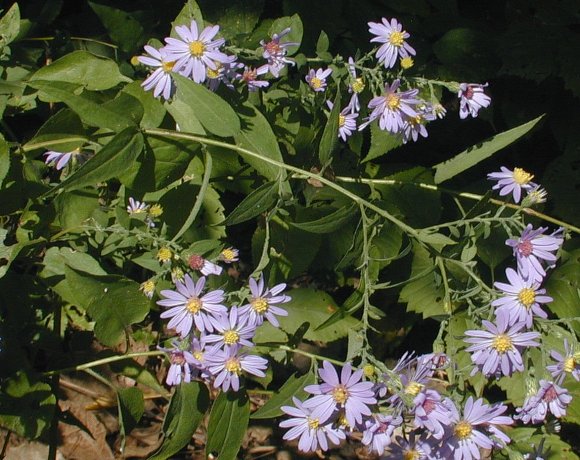
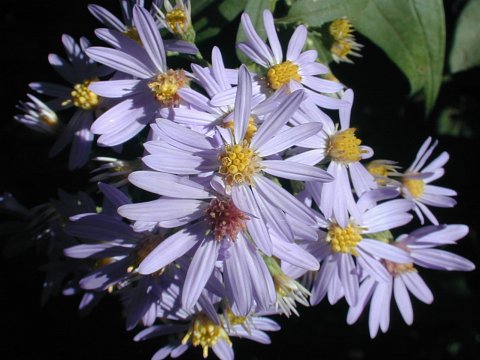
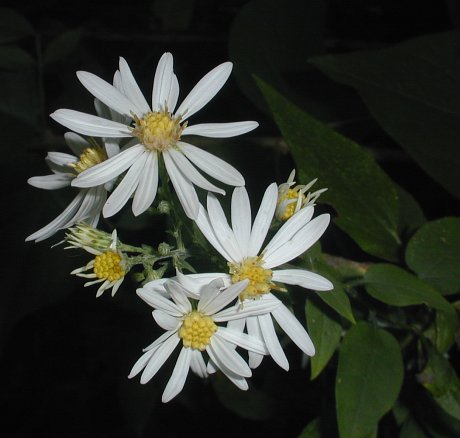
Each flowerhead is about ¾–1" across, consisting of 10-20 ray florets that surround a similar number of disk florets. The petaloid rays of these flowerheads are lavender or pale blue-violet (rarely white), and they are individually linear-oblong in shape. The corollas of the disk florets are short-tubular with 5 minute lobes at their apices. Initially, these corollas are yellow, but they become reddish purple with age. On unusual specimens, these corollas are light pink to nearly white. At the base of each flowerhead, the overlapping phyllaries (scaly floral bracts) are linear-lanceolate and glabrous to finely pubescent. Depending on the stage of their maturity, the phyllaries have patches of dark green that are diamond-shaped near their tips, or they have central veins that are dark green. Otherwise, the phyllaries are light green. The blooming period occurs from late summer through the fall, lasting about 1–1½ months. Both the ray and disk florets can produce fertile achenes. These achenes are 2-3 mm. long and oblongoid in shape; they have small tufts of light brown hair at their apices. As a result, the achenes are distributed primarily by the wind. The root system is fibrous and rhizomatous; older plants sometimes develop a small caudex. Clonal colonies of plants can develop from the rhizomes.
Cultivation:
The preference is partial sun, mesic to dry-mesic conditions,
and soil that contains loam or some rocky material with decaying
organic matter. Calcareous ground with a higher than normal pH is
tolerated. Like many other asters (Symphyotrichum
spp.), the foliage can be attacked by many kinds of
insects and disease organisms.
The plants have a tendency to flop over while in bloom.
Range & Habitat:
The native Short's Aster is a fairly common species that occurs in the
majority of counties in Illinois. However, it is less common in some
southern areas of the state (see Distribution
Map).
Habitats include mesic to upland woodlands, rocky open woodlands and
slopes, limestone bluffs, woodland borders, and areas along
woodland paths. Short's Aster occurs in both oak-hickory woodlands and
maple-basswood woodlands. This aster often occurs in areas where
limestone is close to the surface of the ground; it is usually found in
higher quality natural areas. Wildfires and other kinds of disturbance
can be beneficial if they reduce excessive shade from overhead canopy
trees, or they reduce competition from invasive shrubs.
Faunal Associations: The flowerheads of asters (Symphyotrichum spp.) attract many kinds of insects, especially long-tongued bees, small-tongued bees, butterflies, skippers, and flies. These insects obtain nectar or pollen from the flowerheads. Some bees are specialist pollinators of asters and sometimes goldenrods (Solidago spp.); these species include the plasterer bee Colletes simulans armata, and such Andrenid bees as Andrena asteris, Andrena asteroides, Andrena hirticincta, Andrena nubecula, Andrena simplex, and Andrena solidaginis. The caterpillars of two butterflies, Chlosyne nycteis (Silvery Checkerspot) and Phyciodes tharos (Pearl Crescent), feed on the foliage of asters. In addition, the caterpillars of such moths as Cucullia asteroides (The Asteroid), Carmenta corni (Aster Borer Moth), and many others feed on various parts of asters (see Moth Table). Other insect feeders include Exema canadensis and other leaf beetles, larvae of Calycomyza humeralis (Aster Leafminer Fly), larvae of several fruit flies, many aphids (especially Uroleucon spp.), Macrosteles fascifrons (Aster Leafhopper), the plant bug Plagiognathus cuneatus, and Corythucha marmorata (Goldenrod Lace Bug). Among birds, the Wild Turkey and Ruffed Grouse occasionally eat the seeds and foliage of these plants in woodland areas. Among mammals, both the White-tailed Deer and Cottontail Rabbit undoubtedly feed on the rather smooth foliage of Short's Aster and similar asters.
Photographic
Location:
A woodland edge near Busey Woods in Urbana, Illinois.
Comments:
This is one of the more attractive woodland asters with flowers that
are larger than average in size. Short's Aster (Symphyotrichum shortii)
can be distinguished
from other asters (Symphyotrichum spp.) by carefully
considering the
appearance of the foliage and flowerheads. The lower to
middle leaves of Short's Aster are indented at the base with narrow
petioles. Some asters, such as Symphyotrichum
sagittifolium (Arrow-Leaved Aster), have winged petioles on
their lower to middle leaves, while other asters have rounded
or wedge-shaped bases on their lower to middle leaves. The margins
of leaves in Short's
Aster are devoid of teeth (or nearly so), while other woodland asters,
such as Symphyotrichum cordifolium (Blue Wood
Aster), have
leaf margins with conspicuous teeth. Similarly, the upper leaf surface
in Short's
Aster is hairless (or nearly so), while the upper leaf surface of Symphyotrichum
drummondii
(Drummond's Aster) is pubescent.
Finally, the flowerheads of Short's Aster are usually ¾" across or
more, while the flowerheads of other woodland asters are usually
less than ¾" across. A scientific synonym of this species is Aster shortii.