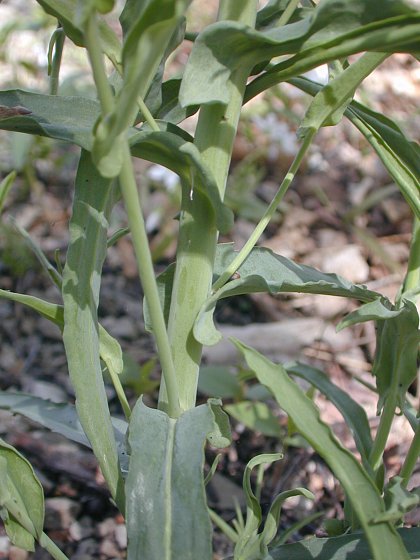
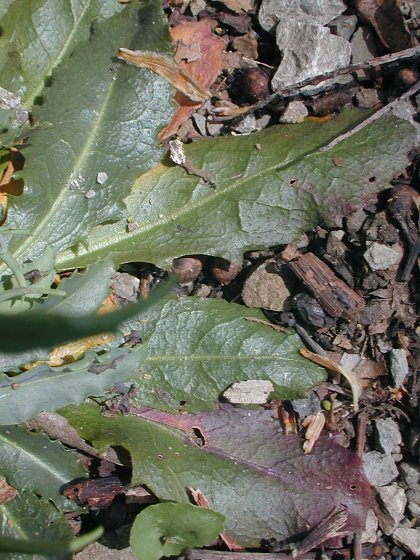
Description: During the first year, this biennial plant consists of a rosette of basal leaves spanning about 6" across. These basal leaves are up to 3½" long and ¾" across; they are obovate or oblanceolate, shallowly lobed or dentate along the margins, and nearly hairless. During the second year, a flowering stalk develops up to 3' tall that is unbranched or sparingly branched; it often leans over to one side. This stalk is pale green, hairless, and glaucous. The cauline (alternate) leaves are up to 8" long and 1" across, becoming smaller as they ascend the central stalk. They are usually lanceolate, hairless, and glaucous; some of the upper leaves are linear. The margins of these leaves are smooth or sparingly dentate. The base of each cauline leaf clasps the central stalk with a pair of basal lobes. Normally, the cauline leaves are some shade of green, but they can become reddish or yellowish green in bright sunlight.
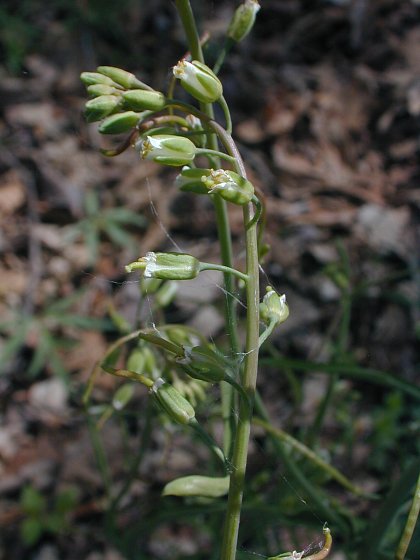
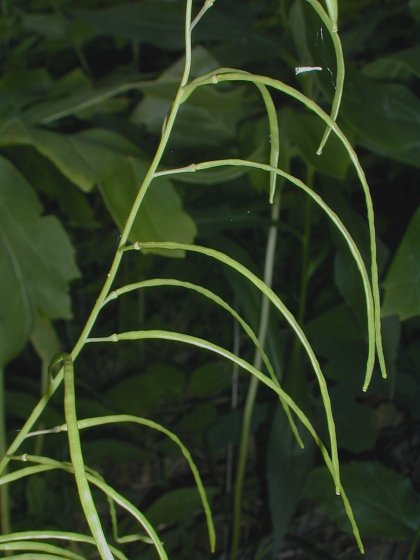
The central stalk (and any secondary stalks) terminates in an elongated raceme of flowers up to 1½' long. The small flowers bloom near the apex of this raceme, while the siliques (slender cylindrical seedpods) droop from their pedicels below. Each flower is about 4 mm. (1/6") across, consisting of 4 white petals, 4 light green sepals, a pistil with an undivided style, and several stamens. The petals are barely longer than the sepals. The pedicel of each flower is about 8 mm. (1/3") long, hairless, and ascending. The blooming period occurs from mid-spring to early summer and lasts about 1-2 months. Each flower is replaced by a slender silique up to 3½" long that is hairless; it contains a single row of small seeds with winged margins. The siliques spread widely or droop from their pedicels. When the siliques split open to release their seeds, the latter can be carried aloft to some extent by the wind. The root system consists of a taproot. This plant spreads by reseeding itself.
Cultivation:
The
preference is medium shade to partial sunlight, moist to slightly dry
conditions, and a soil that is loamy or rocky. The size of a plant and
the appearance of its foliage can be strongly influenced by its growing
conditions.
Range & Habitat:
Smooth Rock Cress occurs occasionally in most areas of Illinois (see Distribution
Map), where it is native. In some areas, it may be locally
common. Habitats
include mesic woodlands, thinly wooded bluffs, rocky slopes of
bluffs, shaded cliffs, and ravines near streams. This plant is
generally found in hilly woodlands where deciduous trees are dominant.
Faunal
Associations:
Small bees and flies occasionally visit the flowers for nectar or
pollen. Bee visitors include Ceratina spp. (little
carpenter bees), Nomada spp. (cuckoo bees), Osmia
spp. (mason bees), Halictid bees, and Andrenid bees,
including Andrena arabis (Rock Cress Andrenid Bee).
Some insects feed on the foliage and other parts of Boechera
spp. and related genera (Rock Cress species); they include
larvae of the leaf-mining
fly Liriomya pusilla,
the flea beetles Phyllotreta
conjuncta and Phyllotreta
punctulata, and caterpillars of the butterflies Anthocharis midea
(Falcate Orangetip) and Pieris
oleracea
(Mustard White). The foliage of these plants doesn't appear to be
bothered by either deer or rabbits to any significant degree (personal
observation).
Photographic Location:
The photographs were taken at a wooded ravine near a
stream in Vermilion County, Illinois, and at a mesic deciduous woodland
in Douglas County, Illinois.
Comments: This is one of the native species of Rock Cress (Boechera spp. and related genera) that can be found in wooded areas. This plant is not particularly showy and it is often overlooked. Smooth Rock Cress (Boechera laevigata) can be distinguished from other species of Rock Cress as follows: 1) It is completely hairless during the blooming period, 2) it has siliques that are widely spreading or drooping, and 3) its cauline leaves clasp their stems with a pair of basal lobes. These three characteristics are usually sufficient to distinguish this species from other species of Rock Cress. Some other characteristics that are occasionally helpful: 1) Its siliques are circular in cross-section, rather than flattened, and 2) each of its siliques contains a single row of seeds. For example, another woodland species, Boechera canadensis (Sicklepod), has an appearance that is similar to Smooth Rock Cress; they both have drooping siliques. However, the cauline leaves of Sicklepod are sessile, its lower foliage is often hairy, and it has flattened siliques. A scientific synonym of Smooth Rock Cress is Arabis laevigata.