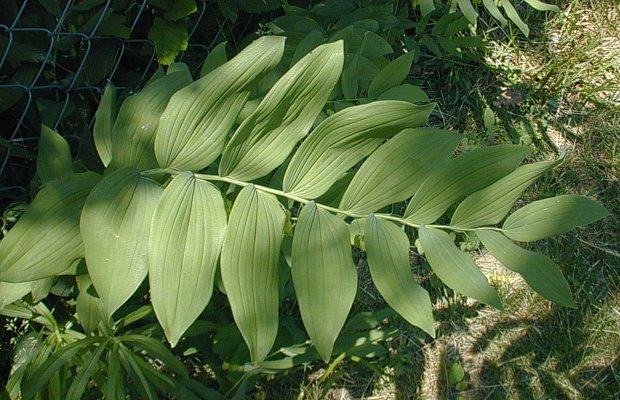
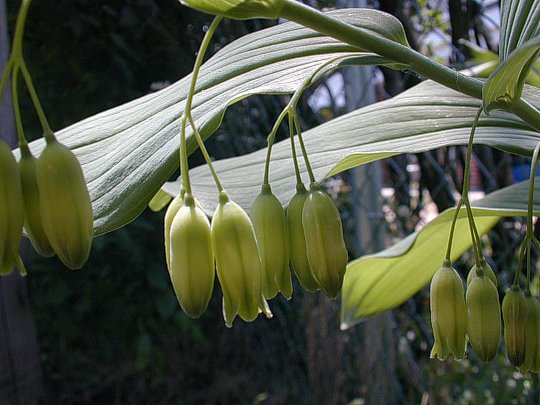
Description: This herbaceous perennial plant is about 2-3½' tall and unbranched. The central stem is glabrous, glaucous, and terete (circular) in circumference; it leans over to one side. The alternate leaves are up to 6" long and 3½" across; they are spaced fairly close together along the stem. These leaves are pale green, elliptic to ovate in shape, smooth (entire) along their margins, and glabrous; they have parallel veins and clasp the stem. From the axils of the middle and upper leaves, there are nodding umbels of 2-5 flowers (rarely more than this). A typical plant will have 12-20 of these umbels, which hang below the leaves. The peduncles (about 1¼" in length) and pedicels (about ½" in length) of the umbels are slender, green, and glabrous. The flowers are about ½-¾" (13-18 mm.) in length. Each flower has a narrow tubular corolla that is whitish green or pale yellowish green. Along the outer rim of this corolla, there are 6 small lobes that are slightly recurved. Within the interior of the corolla, there is a pistil with a single style and 6 stamens.
The blooming
period occurs from late spring to early summer, lasting about 3
weeks. Each flower is replaced by a globoid berry that is about 8-10
mm. across at maturity. The berries are initially green, but they
eventually
become dark blue-violet. The root system produces rhizomes that are
rather stout and knobby; on the upper surface of these rhizomes, there
are circular scars. This plant often forms clonal colonies.
Cultivation:
This plant prefers light shade to partial sun, mesic levels
of moisture, and fertile loamy soil. It is fairly rugged and
tolerates less than ideal conditions. The foliage persists all summer
and it is rarely bothered by disease.
Range & Habitat:
The native Solomon's Seal is a common plant that occurs in every county
of
Illinois (see Distribution
Map). Habitats include moist to slightly dry deciduous
woodlands, lower wooded slopes, edges of shady seeps, young flatwoods,
woodland borders, and fence rows that are overgrown with shrubs or
trees. Less often, Solomon's Seal may occur in meadows near woodlands
and open prairies, especially cemetery prairies. Solomon's
Seal occurs in both high quality and degraded woodlands.
Faunal
Associations:
The nectar and pollen of the flowers attract various bees, including
bumblebees, Anthophorid bees (Anthophora
spp.), and Halictid bees (Lasioglossum spp.).
The Ruby-Throated Hummingbird also feeds on nectar from the flowers.
Other insects feed destructively on the foliage and other parts of
Solomon's Seal. These species include the aphid, Catamergus kickapoo,
which sucks sap from the leaf undersides; adults of a thrips, Ctenothrips bridwelli,
which are found on the foliage; leaf-rolling larvae of the moth, Clepsis melaleucana
(Black-Patched Clepsis), which feed on foliage or flowers; and larvae
of the sawflies, Phymatocera
racemosa and Phymatocera
smilacinae,
which feed on the foliage. The berries are eaten by the Greater Prairie
Chicken and various woodland birds. White-Tailed Deer are quite fond of
the foliage and will chomp off the tops of plants to about 6" above the
ground.
Photographic Location:
Along a shady fence row near the webmaster's apartment complex in
Urbana, Illinois, and a shaded wildflower garden at the University of
Illinois in the same city.
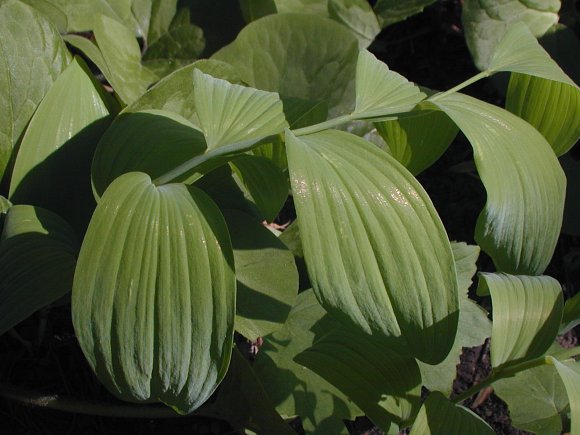
Comments: The foliage of Solomon's Seal (Polygonatum commutatum) is attractive, while the flowers aren't very showy. Other Polygonatum spp. in Illinois have a similar appearance, but they are far less common. One species, Polygonatum pubescens (Pubescent Solomon's Seal) is pubescent on the undersides of its leaves (particularly along the veins), while the undersides of the leaves of Solomon's Seal are hairless. Another species, Polygonatum biflorum (Small Solomon's Seal), is slightly smaller in size with sessile leaves, while the leaves of Solomon's Seal clasp the central stem. There is an uncommon polyploid variant of Solomon's Seal that produces leafy stems about 3½-6' tall (or long) and its umbels often have more than 5 flowers. This variant is sometimes referred to as Giant Solomon's Seal. It prefers moist wooded areas, such as floodplain woodlands. Another group of plants with similar foliage, Smilacina spp. (False Solomon's Seal species), produce terminal panicles of flowers, while Polygonatum spp. (Solomon's Seal species) produce non-terminal umbels of flowers from the axils of their leaves.