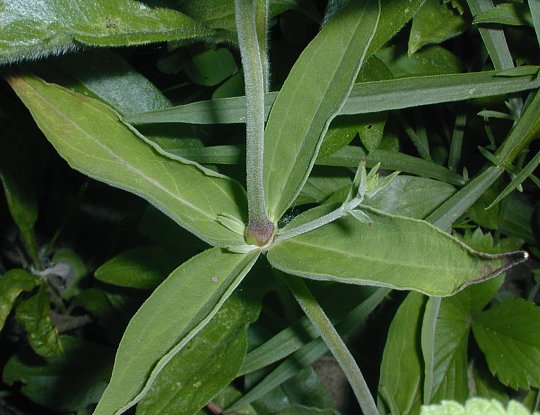
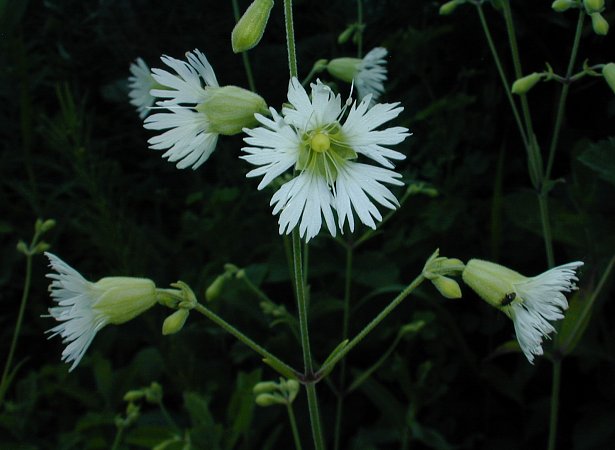
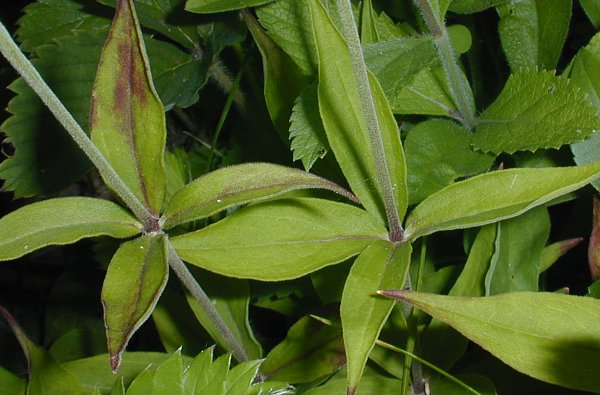
Description: This herbaceous perennial plant is 1–2½' tall and usually erect. It is unbranched or branched sparingly. The terete central stem and any lateral stems are mostly pale green to pale reddish green, hairless to densely pubescent, and somewhat swollen at the bases of leaves, where it is sometimes reddish purple. The lowermost and uppermost leaves are usually opposite, while the middle leaves occur in whorls of 4. They are up to 4" long and 1½" across, elliptic or lanceolate in shape, smooth along the margins, and sessile. The upper surface of each leaf is yellowish green, greyish green, or medium green, and hairless, while the lower leaf surface is more pale and hairless to finely pubescent. The central stem terminates in a panicle of flowers up to 8" long and about 3-4" across. On robust plants, 1-2 additional panicles may be produced from upper lateral stems. Pairs of small leafy bracts occur wherever a panicle branches. The erect central stalk, ascending branches, and clustered pedicels of the panicle are pale to medium green, terete, and hairless to finely pubescent. The flowers occur individually or in groups of 2-3 at the tips of long lateral branches on short pedicels. These pedicels are less than ¼" long.
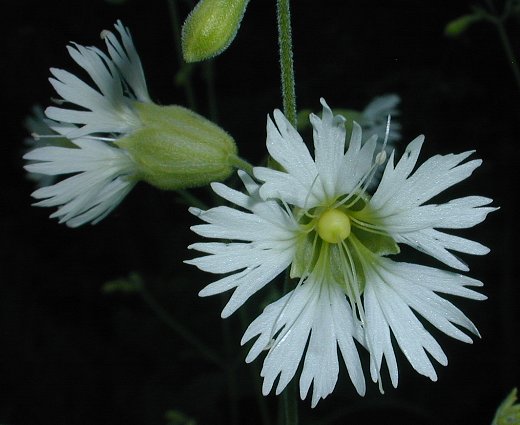
Each flower is about ¾" across, consisting of 5 white fringed petals, a light green calyx that is bell-shaped (campanulate) with 5 broad teeth along its upper rim, a pistil with 3 slender white styles, and 10 stamens with slender white filaments. Each fringed petal has 8-12 linear lobes along its broad outer edge, while at the base it becomes quite narrow. The outer surface of each calyx is light green and hairless to finely pubescent; it often has faint longitudinal veins that are a darker shade of green. The blooming period occurs during mid- to late summer, lasting about 3-4 weeks. There is no noticeable floral scent. The flowers remain open during the evening, night, and early morning. In the presence of bright sunlight, they have a tendency to close-up during the middle of the day. Each flower is replaced by an ovoid seed capsule with 6 teeth along its upper rim; each capsule contains several seeds. The flattened seeds are reniform or reniform-orbicular with a fine pebbly surface. The root system consists of a deep white taproot. An older plant may tiller from its base, sending up multiple stems from the same taproot. Starry Campion reproduces by reseeding itself.
Cultivation:
The
preference is light shade or partial sun, mesic to dry conditions,
and soil containing loam, clay-loam, or a little rocky
material. When
exposed to full sunlight, the leaves become yellowish green and they
are less attractive. Sometimes the stems lean sideways when
this plant is
grown in the fertile soil of flower gardens.
Range & Habitat:
The native Starry Campion is widely distributed in Illinois, where it
occurs occasionally in most counties (see Distribution
Map). There are two varieties of Starry Campion that can be
found throughout the state, Silene stellata stellata
and Silene stellata scabrella. The typical variety
of this species is hairless (or nearly so), while var. scabrella is
quite pubescent, as indicated above. Habitats include upland rocky
woodlands, wooded slopes, savannas, shaded banks of
rivers, meadows near wooded areas, and cemetery
prairies. This conservative species is usually
found in higher quality natural areas. Fire and other kinds of
disturbance are beneficial if they reduce dense shade from Acer saccharum
(Sugar Maple) and invasive shrubs.
Faunal Associations: The flowers are pollinated primarily by moths and, to a lesser extent, by bumblebees. These insects suck nectar from the flowers. The caterpillars of a rare Noctuid moth, Hadena ectypa (Campion Coronet), feed primarily on the flowers and developing seed capsules of Starry Campion. This moth also sucks nectar from the flowers of this plant (Nelson, 2012). The caterpillars of a closely related moth, Hadena capsularis (Capsule Moth), feed on the flowers and developing seed capules of several species in the Pink family, including Silene spp. The caterpillars of this latter moth may also feed on Starry Campion. Another insect, Aphis sambuci (Elder Aphid), uses Silene spp. as summer hosts and feeds on the sap of their roots. Among vertebrate animals, White-tailed Deer occasionally chomp off the tops of Starry Campion (personal observation), even though its foliage, like other Silene spp., probably contains some saponins and alkaloids that are known to be at least mildly toxic.
Photographic
Location:
The wildflower garden at the apartment complex of the webmaster in
Urbana, Illinois. The plants in the photographs are the pubescent
variety of Starry Campion, or Silene stellata scabrella.
Comments:
The flowers of Starry Campion are quite beautiful. It should be grown
more often in flower gardens. This species is easy to identity because
of its deeply fringed petals and whorled leaves. Other white-flowered Silene
spp. (campions) lack deeply fringed petals and their leaves
always occur in opposite pairs. While the flowers of Starry Campion are
perfect (bisexual), the flowers of some campions are dioecious
(individual plants have either all male flowers or all female flowers,
but not both). An example of a dioecious species in this genus is the
introduced Silene
pratensis (Evening Campion).