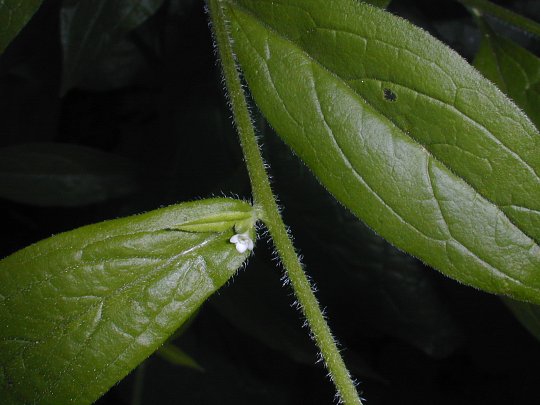
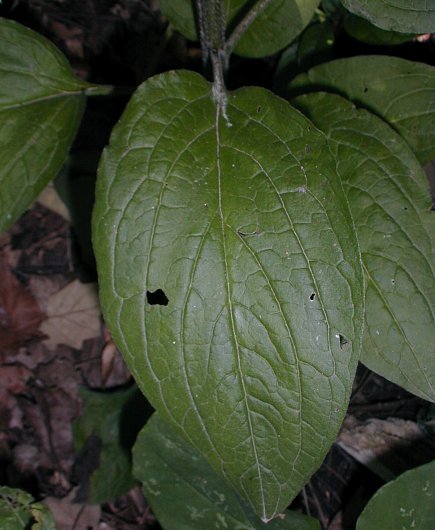
Description: This biennial plant forms a rosette of leaves during the first year. During the second year, it becomes a rather lanky plant about 2-4' tall that branches occasionally. The stems have abundant white hairs; the lower central stem is often ribbed. The basal and lower leaves are up to 6" long and 3½" across; they are cordate-ovate or ovate with petioles up to 2" long. The upper leaves are lanceolate to elliptic and sessile, otherwise they are similar to the lower leaves. All leaves have smooth (entire) and slightly ciliate margins. The upper leaf surface is dark green and sparsely covered with short stiff hairs, while the lower leaf surface is medium green and more hairy, especially along the major veins. Both the lower and upper leaves alternate along the stems. The upper stems terminate in flowering racemes about 4-12" long; sometimes shorter racemes or individual flowers develop from the axils of the upper leaves. The stalks (peduncles) of these racemes are pubescent or hairy, and small leafy bracts may develop underneath some of the flowers. The pedicels of the flowers are pubescent or hairy and up to ¼" (6 mm.) in length.
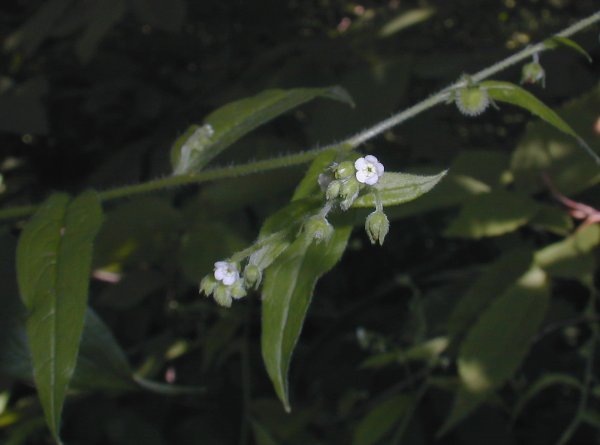
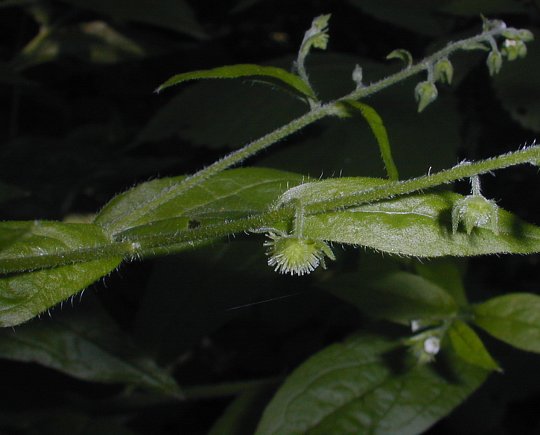
Each flower is about 1/8" (3 mm.) across, consisting of 5 petals and a pubescent green calyx with 5 slender teeth. The petals are white and well-rounded; less often, they are light blue. The blooming period occurs during the summer, lasting about 2-3 months. Only a few flowers are in bloom at the same time and they are fairly inconspicuous. The flowers are replaced by prickly subgloboid fruits (about 4-6 mm. across) that hang downward from short slender pedicels (one fruit per flower). Hooked prickles densely cover the surfaces of these fruits. The fruits are initially whitish green, but later they later become brown. Each fruit contains 4 nutlets. The root system consists of a taproot. This plant spreads by reseeding itself; it occasionally forms colonies.
Cultivation: The
preference is partial sun to medium shade, mesic conditions, and a
fertile loamy soil. However, this plant tolerates different kinds of
soil and moisture conditions and it is quite adaptable.
Range & Habitat:
The native Stickseed is common in central and northern Illinois, and
locally common to absent in the southern section of the state (see Distribution
Map). Habitats include moist to slightly dry deciduous
woodlands, woodland borders, powerline clearances in wooded areas,
thickets, and shady fence rows. Stickseed prefers disturbed wooded
areas and it is rather weedy. This plant sometimes occurs in wooded
areas where there has been a recent fire, as well as degraded wooded
areas that are subjected to occasional grazing by cattle.
Faunal
Associations:
The nectar of the flowers attracts Halictid bees (Halictus spp., Lasioglossum spp.)
and Syrphid flies, particularly Syritta pipiens. A
flea beetle, Longitarsus
melanurus, feeds on the leaves of Stickseed and other
members of the Borage family. The bitter foliage is avoided by deer and
other mammalian herbivores. When there is an overpopulation of deer in
wooded areas, Stickseed often becomes more common. The bur-covered
fruits can cling to the fur of mammals and clothing of humans; by this
means, they are introduced into new areas.
Photographic Location: Edge
of a wooded area at Busey Woods in Urbana, Illinois.
Comments: This is another woodland wildflower with small white flowers that blooms during the summer in shaded areas. The most distinctive characteristic of Stickseed (Hackelia virginiana) are the prickly fruits that hang downward from its slender racemes. Another species in the Borage family, European Stickseed (Lappula squarrosa), has similar racemes of prickly fruits. However, the prickles of its fruits are arranged in columns with spaces in-between. In contrast, the fruits of Stickseed are densely covered with prickles throughout. European Stickseed is shorter than Stickseed and its leaves are more slender. This introduced species prefers sunny areas, while the native Stickseed prefers wooded areas with some shade. An older scientific name for Stickseed is Lappula virginiana.