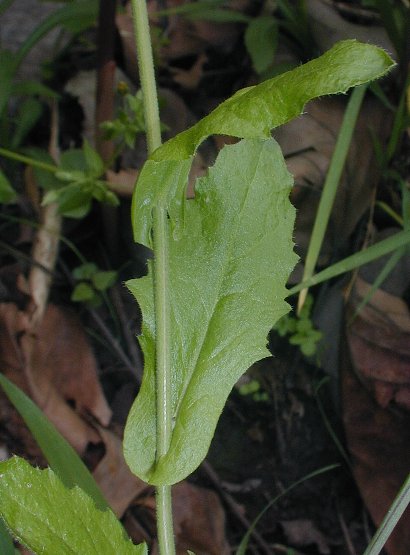
Description: This plant is a biennial that consists of a rosette of basal leaves during the first year. The basal leaves are up to 6" long and 2" across; they are oblanceolate or obovate, dentate along the margins, and hairy underneath. Each basal leaf tapers to a petiole-like base that is long and slender, while its tip is acute to blunt. During the second year, one or more stems with alternate cauline leaves develop from the center of the rosette, which withers away. Upon reaching maturity, Toothed Rock Cress is 1½–3' tall. The erect to ascending stems are light green, finely pubescent, terete, and sparingly branched. The cauline leaves are up to 4" long and 1½" across; they are oblanceolate to obovate and dentate along their margins. The upper surface of each cauline leaf is sparingly covered with fine hairs or hairless, while the lower surface is conspicuously hairy. Each cauline leaf clasps the stem with a pair of basal lobes (it is auriculate). The upper stems terminate in floral racemes up to 1' long.
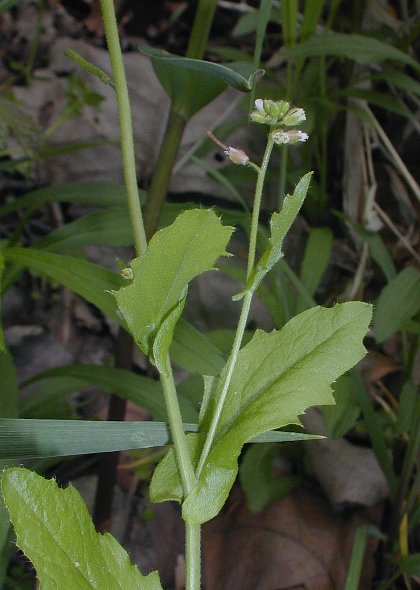
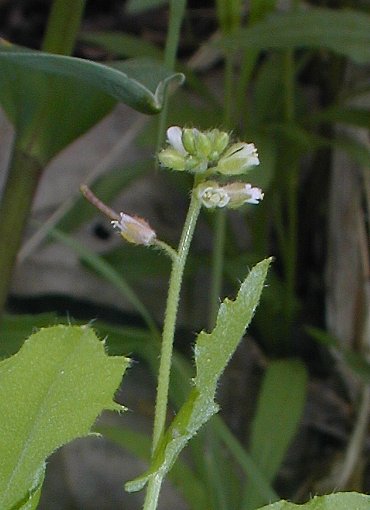
Each flower is
about 1/8" (3 mm.) across, consisting of 4 sepals, 4 petals, an ovary
with a
short style, and several stamens with pale yellow or white
anthers. The petals are white and oblanceolate; they barely extend
beyond the sepals. The sepals are lanceolate-oblong, light green to
reddish green, and finely hairy. The pedicel of each flower is short,
stout, and conspicuously hairy. The blooming period occurs during the
late spring or early summer and lasts about a month. Each flower is
replaced by a slender cylindrical silique about ¾–1½" long that
contains a single row of seeds. The siliques are ascending to spreading
along the central stalk of the raceme; they can be curved or straight,
but don't droop conspicuously. The outer surface of each
silique is light green to reddish purple and glabrous or finely
pubescent (usually the latter). The seeds are quite small (about 1 mm.
long), oblongoid, and somewhat flattened; they lack winged margins. The
root system consists of a taproot. This plant spreads by reseeding
itself.
Cultivation:
This plant is typically found in dappled sunlight to medium shade,
moist conditions, and either fertile loamy soil or thin rocky soil with
decaying organic matter.
Range &
Habitat:
The native Toothed Rock Cress occurs occasionally in northern and
central Illinois, while in the southern section of the state it is
uncommon or absent (see Distribution
Map). Habitats include moist to
mesic deciduous woodlands, wooded floodplain areas along rivers, banks
of small streams, rocky bluffs, and shaded limestone cliffs.
Faunal Associations:
The small flowers attract various bees, Syrphid flies, dance flies (Empis
spp.), and miscellaneous other insects. The bee visitors
include cuckoo bees (Nomada spp.), Halictid bees,
Andrenid bees, and little carpenter bees (Ceratina spp.). The
bees suck nectar or collect pollen, while the flies suck nectar or feed
on pollen. Some flea beetles (e.g., Phyllotreta conjuncta
and Phyllotreta
punctulata) feed on species of Rock Cress (Boechera spp. and
related genera).
Photographic Location:
A low wooded area along a river in Vermilion County, Illinois.
Comments: This is one of the woodland species of Rock Cress (Boechera spp. and related genera). As a group, they are usually tall-growing, but not very showy because of their small flowers. It can be somewhat tricky to distinguish these species and several physical characteristics should be considered. Toothed Rock Cress (Boechera dentata) has: 1) stems with pubescent hairs throughout, 2) terete siliques that are spreading to ascending (but not drooping nor stiffly erect), 3) auriculate leaves with basal lobes that clasp each stem throughout its length, and 4) very small flowers (about 1/8" or 3 mm. across). Other species of Rock Cress often have: 1) hairless stems or stems that are hairy only toward the bottom, 2) siliques that are flattened, droop downward, or are held stiffly erect, 3) cauline leaves that are sessile, or they have basal lobes that clasp each stem only toward the bottom, and 4) flowers that are slightly larger in size. Other scientific names of Toothed Rock Cress include Arabis dentata and Arabis shortii.