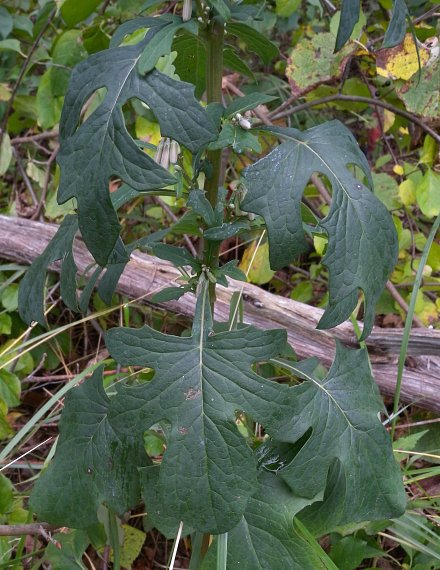
Description: This herbaceous perennial wildflower is 2-5' tall; it has an erect central stem and often develops short side stems in the upper half. The central stem is terete, light green to purple (usually the latter), glabrous, and glaucous. The alternate leaves are up to 8" long and 6" across (excluding the petioles), becoming gradually smaller as they ascend the stems. The leaves are variable in shape; they are usually 3-5 lobed and less often deltate or ovate. The margins of these leaves are dentate, undulate, or smooth. The upper surface of each leaf is medium to dark green and glabrous. The winged petioles are as long as their leaf blades or shorter. Both the stems and leaves contain a milky white latex. The central stem and upper stems (if any) terminate in panicles of flowerheads up to 2' long and 1' across. Each panicle has a central stalk that divides at its apex into 2-4 spreading branches; there may be some lower branches below. From each branch, several flowerheads droop downward from very short branchlets and peduncles. The light green to purple branches, branchlets, and peduncles of each panicle are glabrous.
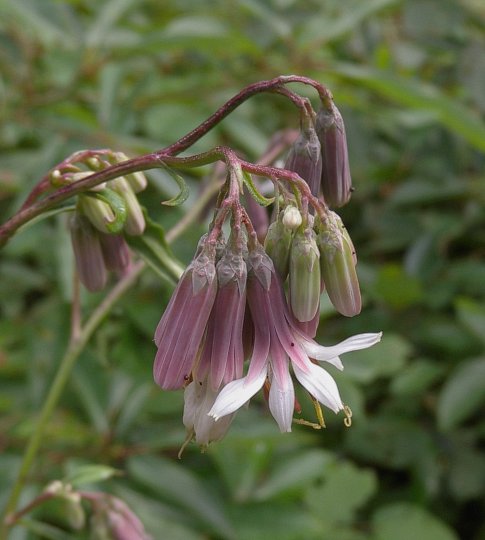
Each flowerhead is
about ¾" long and ½" across. The cylindrical base of each flowerhead
has 8 primary bracts (phyllaries) that are linear in shape,
pale greenish purple to purple, and glabrous. There are also
several secondary bracts at the very bottom of the flowerhead that are
much shorter than the primary bracts. The upper flowerhead has 8-14
outer ray florets and no disk florets; the petaloid rays of these
florets spread outward widely when the flowerhead is in bloom. These
petaloid rays are pale purple, lavender, or white; they are linear in
shape with minutely toothed truncate tips. The blooming period occurs
from late summer into the fall. A pleasant floral fragrance is
sometimes present. The florets are replaced by small oblongoid
achenes with tufts of cinnamon-brown hair at their apices; the
achenes are distributed by the wind. The root system is fleshy.
Cultivation:
Preferred growing conditions consist of light shade to dappled
sunlight, average levels of moisture, and a fertile loamy soil. Soil
that is sandy or rocky is also tolerated. The size of individual plants
is strongly influenced by moisture amounts, light levels, and soil
fertility.
Range &
Habitat:
The native White Lettuce is occasional in the northern half of
Illinois, but it is rare or absent elsewhere within the state (see Distribution
Map). This species is more common in areas that lie north and
east of the state. Habitats include rich mesic woodlands, sandy
woodlands, stabilized sand dunes with scattered trees, bluffs, wooded
slopes, rocky ravines and cliff bases in wooded areas, and
woodland borders. White Lettuce can be found
in oak, maple-basswood, and other deciduous woodlands.
Faunal Associations:
The flowerheads are cross-pollinated by bumblebees, which seek nectar.
The following aphids have been observed on White Lettuce: Hyperomyzus nabali,
Uroleucon ambrosiae,
and Uroleucon
chrysanthemi. Even though the foliage of this species has
a bitter taste, it is sometimes browsed by White-Tailed Deer.
Photographic Location:
A stabilized sand dune at Indiana Dunes State Park near Lake Michigan.
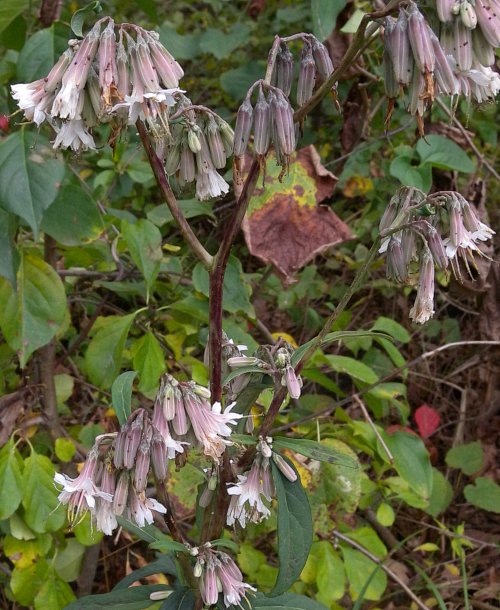
Comments: White Lettuce is one of five Prenanthes spp. in Illinois; two of these species occur in prairies, while the other three species occur in woodlands. The prairie species in this genus have narrow spikes of flowerheads and lanceolate leaves. The woodland species in this genus have spreading panicles of flowerheads and their leaves are often lobed (particularly the lower ones). White Lettuce can be distinguished from the other woodland species in Illinois by its primary bracts (phyllaries): Each flowerhead has 8 primary bracts that are pale purple-green and hairless. In contrast, each flowerhead of Prenanthes altissima (Tall White Lettuce) has 5 primary bracts that are light green and hairless, while the flowerhead of Prenanthes crepidinea (Great White Lettuce) has 12-15 primary bracts that are light green and hairy. These species also differ in the number of outer ray florets per flowerhead. Other common names of Prenanthes alba are Lion's Foot and Rattlesnake Root.