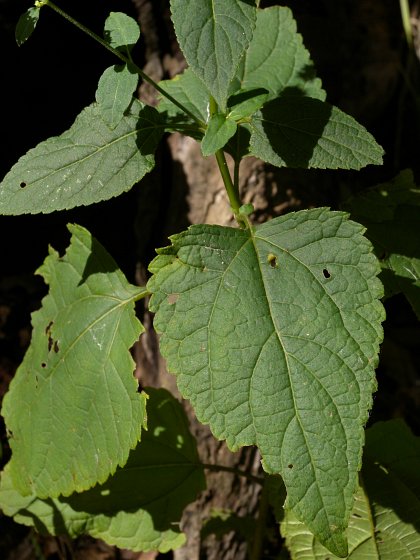
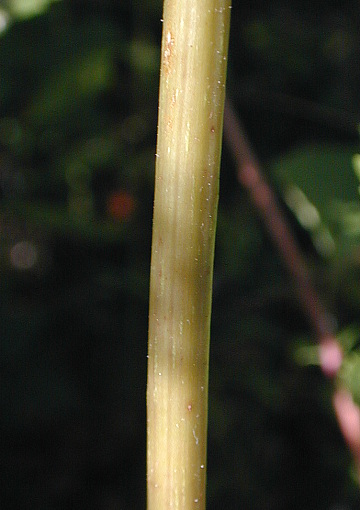
Description: This herbaceous perennial plant is about 1½–3' tall, branching occasionally. The light green to tan stems are terete and hairless (or nearly so). The opposite leaves are up to 5" long and 3½" across, becoming smaller as they ascend the stems. The lower leaves are cordate to cordate-ovate, while the upper leaves are broadly lanceolate to lanceolate. All of the leaves are largely hairless and strongly serrated-crenate along their margins; they are medium to dark green on their upper surfaces and light green on their lower surfaces. There are 3 prominent veins on the upper surface of each leaf (particularly the lower ones), while the lower surface has an elevated network of veins. The rather long petioles are ½–2½" in length.
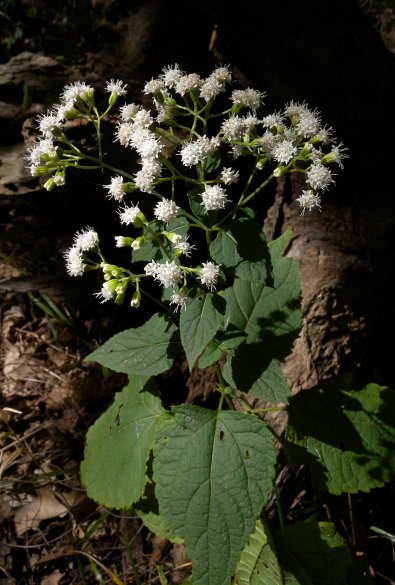
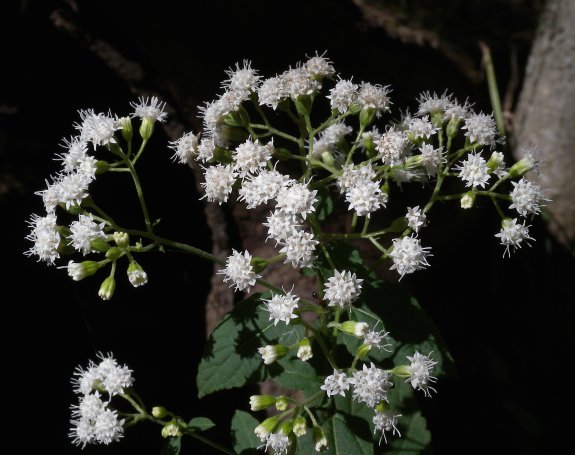
The upper stems terminate in compound corymbs or flat-headed panicles of flowerheads that span 2-6" across. The branches of this inflorescence are light green and glabrous (or nearly so). Each flowerhead is about ½" across and contains 10-30 disk florets that have brilliant white corollas and styles. There are no ray florets. Each disk floret is about 3-5 mm. across when it is fully open, consisting of a small tubular corolla with 5 lobes that are spreading and pointed and a divided style that is strongly exerted from the corolla. At the base of each flowerhead, there is a single series of linear floral bracts that are light green and non-overlapping. The blooming period occurs from late summer through the fall, lasting about 2 months for a colony of plants. This is one of the last wildflowers to bloom during the fall. The flowers are often fragrant.
During autumn, each disk floret
in a flowerhead is replaced by an achene with a small tuft of
white hairs. These achenes are 2-3 mm. long, narrowly
oblongoid in shape, 5-ribbed, and black; they are distributed
by the wind. The root system consists of spreading rhizomes and shallow
fibrous roots. This plant can spread vegetatively by means of its
rhizomes, or it can reseed itself into new areas.
Cultivation:
The preference is partial sun to light shade, moist to slightly dry
conditions, and soil containing loam or clay-loam. Full sun in
a dry situation can cause the leaves to turn yellow and wilt, otherwise
this plant is easy to grow.
Range & Habitat: The native White Snakeroot is a common plant that occurs in almost every county of Illinois (see Distribution Map); it is quite likely that this species occurs in every county. Habitats include moist to slightly dry deciduous woodlands, woodland borders, thickets, partially shaded to shady seeps, bluffs, woodland meadows along rivers, powerline clearances in woodlands, shady corners of pastures and yards, fence rows with woody vegetation, and overgrown vacant lots. This species is especially common in wooded areas that are rather disturbed and degraded, although it also occurs at higher quality sites.
Faunal
Associations:
The nectar of the flowers attracts a variety of insects,
including leaf-cutting bees (Megachile
spp.),
Halictid bees, wasps, various flies (Syrphid, Tachinid, bee flies,
& others), butterflies, and moths. The bees also collect
pollen. The caterpillars of some moths are known to feed on the foliage
and other parts of Eupatorium spp. (Bonesets),
including White Snakeroot (probably). These species include Carmenta
bassiformis (Eupatorium Borer Moth), Papaipema
cataphracta (Burdock Borer Moth), Phragmatobia
fuliginosa (Ruby Tiger Moth), Phragmatobia
lineata (Lined Ruby Tiger Moth), and the Gracillariid moth Leucospilapteryx venustella.
Other insect feeders include larvae of the gall flies Asphondylia eupatorii and
Neolasioptera eupatorii,
the aphids Uroleucon
eupatoricolens and Uroleucon
eupatorifoliae, and the leaf beetle Sumitrosis inaequalis.
Because the foliage is bitter and toxic, mammalian herbivores usually
avoid
this plant as a food source. Sometimes cattle will eat it in overgrazed
pastures, which can produce fatal results.
Photographic Location:
A powerline clearance at Busey Woods in Urbana, Illinois, and a
deciduous woodland in east-central Illinois.
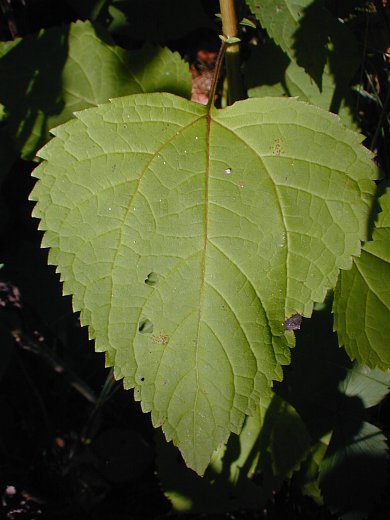
Comments: The common name of this species derives from the erroneous belief among early settlers that the bitter rhizomes were beneficial in the treatment of snakebites. In fact, the foliage and rhizomes are highly toxic, causing fatalities from 'Milk Sickness' because the toxins can pass through the milk of dairy cattle to humans. White Snakeroot has been reassigned recently to the genus Ageratina, although it is still often referred to as Eupatorium rugosum. Normally, White Snakeroot is largely hairless, although some authorities describe a pubescent variety of this species. White Snakeroot resembles many of the white-flowered Eupatorium spp. (Bonesets), but these different species can be distinguished from each other by the appearance of their leaves. Among the species in this group, White Snakeroot has the broadest leaves; its lower leaves are cordate or broadly ovate, and these leaves have long petioles. White Snakeroot usually occurs in and around shady woodlands, while many of these other species are found in prairies and sunny wetlands.