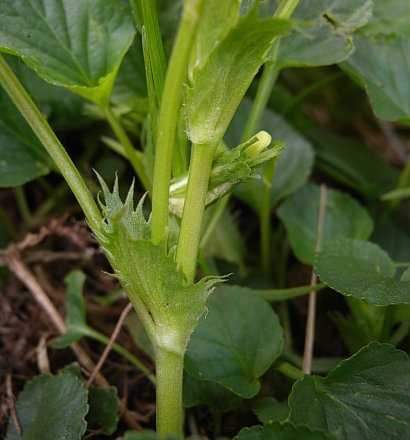
Description: This herbaceous perennial plant produces a stem about ½–1' long that often sprawls across the ground or leans against adjacent vegetation. This stem is light green and glabrous. The alternate leaves are up to 2½" long and 2" across; they are orbicular-cordate to cordate, medium green, mostly hairless, and crenate along their margins. While some young leaves are initially pubescent, they later become mostly hairless. The petioles of these leaves are light green and hairless; they are about as long as the leaves. At the base of each petiole, there is a pair of large stipules up to 1" long. These stipules are light green, lanceolate to ovate in shape, and hairless; they have conspicuous narrow teeth along their margins. Individual flowers develop from the axils of the leaves on slender pedicels. These pedicels are up to 4" long; they are erect to ascending, light green, and hairless. The apices of these pedicels are abruptly curved downward so that the flowers are more or less horizontal.
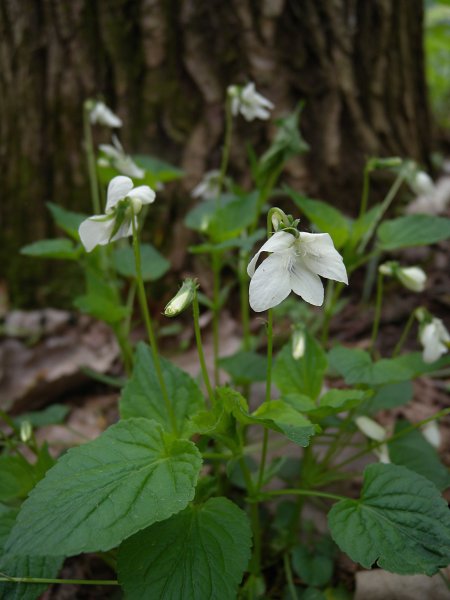
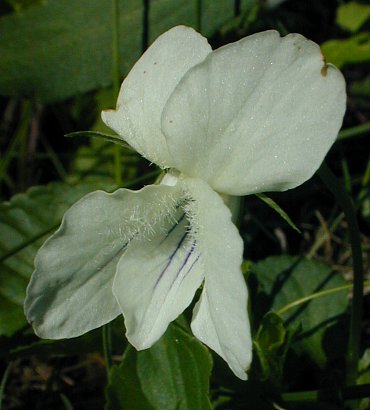
Each flower is about ¾" across, consisting of 5 white rounded petals, 5 light green sepals, a pistil, and inserted stamens. The two lower lateral petals have patches of fine white hairs (or beards) near the throat of the flower, while the lowermost petal has purple veins that function as nectar guides. The nectar spur of the flower is rather short and blunt. The throat of the flower is white, rather than yellow. The sepals are linear-lanceolate in shape and hairless; they are shorter than the petals. The blooming period occurs from mid-spring to early summer, lasting about 1½ months for a colony of plants. There is no noticeable floral scent. If these flowers are cross-pollinated, they will produce ovoid seedpods that are about ¼" in length and glabrous. Later in the year, inconspicuous cleistogamous flowers are produced; they are self-fertile and lack showy petals. At maturity, each seedpod splits open into 3 parts to eject its seeds. These seeds are about 2 mm. across, globoid in shape, and brown. The root system produces rhizomes and fibrous secondary roots. This plant can form clonal offsets through its rhizomes. It sometimes forms colonies.
Cultivation:
The preference is light shade to partial sun, moist to mesic
conditions, and a rich loamy soil. This species doesn't invade lawns
because its stems are too long. It is relatively easy to cultivate in
gardens.
Range & Habitat:
The native Striped White Violet is fairly common in the southern half
of Illinois, but in the northern half of the state it is uncommon or
absent (see Distribution
Map). Habitats include moist to mesic deciduous woodlands,
banks of rivers and streams in shaded areas, open woodlands, woodland
borders, moist meadows, shrubby hedges, and ditches. This violet is
found in both high quality natural areas and more degraded sites that
have a history of minor to moderate disturbance.
Faunal
Associations:
The nectar and pollen of the flowers attract bees, including
bumblebees, long-horned bees (Synhalonia
spp.), mason bees (Osmia
spp.), and Andrenid bees (Andrena spp.).
One of these species, Andrena violae (Violet
Andrenid Bee), is a specialist pollinator (oligolege) of violets (Viola spp.).
Sometimes the Giant Bee Fly (Bombylius
major),
butterflies, and skippers visit the flowers for nectar, but they are
less effective at pollination. Other insects use the leaves and other
parts of violets as sources of food. These insects include the larvae
of gall flies, the larvae of sawflies, the caterpillars of various
moths, the caterpillars of Fritillary butterflies, aphids, and others;
see the Insect Table
for a list of these species. The seeds of violets are distributed to
some extent by ants because of their oily coatings. Some upland
gamebirds and small rodents eat the seeds to a limited extent,
including the Mourning Dove, Ruffed Grouse, Bobwhite
Quail, Wild Turkey,
and White-footed Mouse. In addition, the foliage of violets is eaten to
a limited extent by the Cottontail Rabbit, while their rhizomes are
eaten by the Eastern Chipmunk.
Photographic Location:
A wooded area of Meadowbrook Park in Urbana, Illinois; a flower garden
in Urbana, Illinois; a deciduous woodlands at Goll's Woods Nature
Preserve in NW Ohio; a deciduous woodlands at the Portland Arch in
west-central, Indiana.
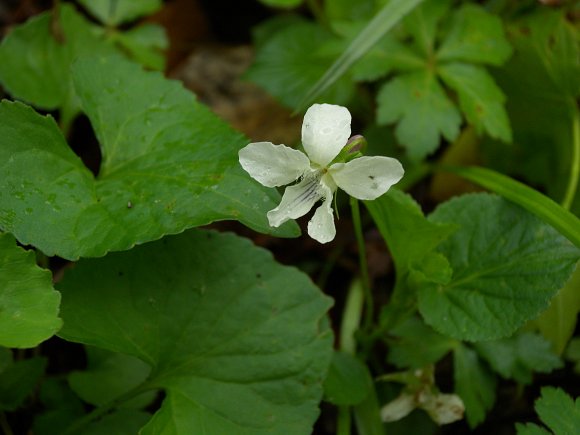
Comments: Striped White Violet (Viola striata) is a rather tall and attractive species that blooms later than most violets (Viola spp.). It also has a longer than average period of bloom than most violets because its flowers are produced as the stems become longer. There are several species of violets in Illinois that produce white flowers. The Striped White Violet belongs to a group of violets in which the leaves and flowers are produced from stems – the other violets belong to a group in which their flowers and leaves are produced directly from their root systems. The Striped White Violet has unusually large stipules (up to 1" long) at the bases of its petioles; the margins of these stipules have abundant fringe-like teeth. These two characteristics separate this species from other white-flowered violets in Illinois. A similar species, the Canada Violet (Viola canadensis), produces white flowers from stems, but its stipules are quite small and they lack conspicuous teeth along their margins. A form of the Common Blue Violet (Viola pratincola alba) also produces white flowers, but this is a stemless violet. Other common names for Viola striata are Cream Violet and Pale Violet.