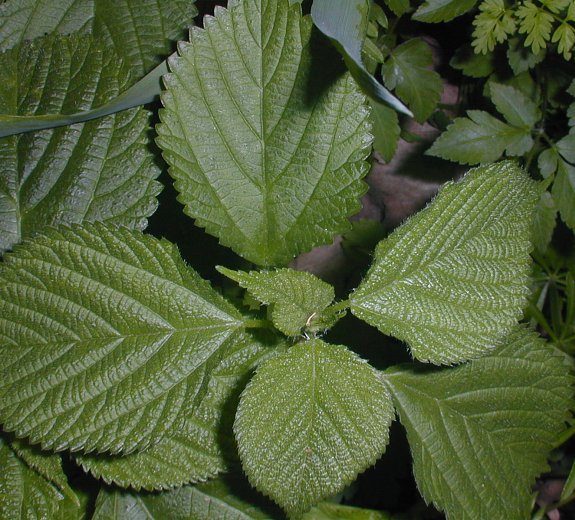
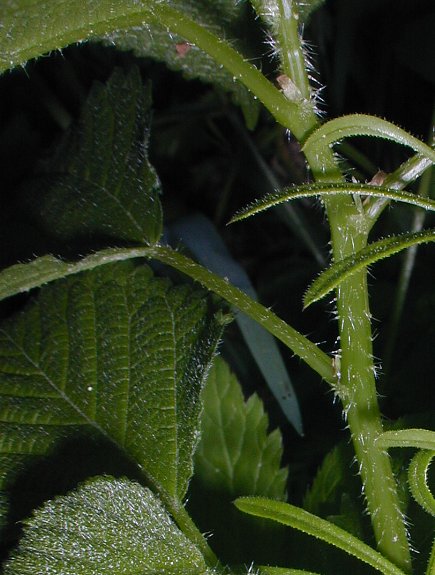
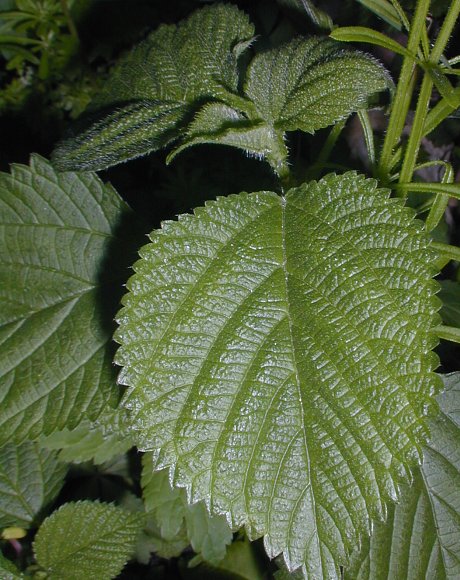
Description: This herbaceous perennial plant is about 2-4' tall and either branched or unbranched. The stems are light to medium green and abundantly covered with stiff white hairs that have the capacity to sting when they are rubbed against. The lower to middle leaves are alternate, while the upper leaves are opposite. These leaves are up to 6" long and 4" across; they are medium to dark green, ovate-cordate to oval-ovate in shape, and coarsely serrated or serrated-crenate. Young leaves are densely hairy and wrinkled in appearance, while older leaves become less hairy and wrinkled with age. Leaf venation is pinnate. The petioles are up to 4" long and abundantly covered with stinging hairs, like the stems. The leaves may have a few stinging hairs as well, particularly along the central veins of their undersides. Some plants have a tendency to loose many of their stinging hairs as the season progresses. Individual plants are either monoecious (separate male and female flowers on the same plant) or unisexual.
The male
flowers occur in branching cymes from the axils of the leaves. These
cymes spread outward from the stem and they are about the same length
as the petioles of the leaves. Each male flower is greenish white to
white and less than 1/8" (3 mm.) across, consisting of 5 narrow sepals,
5 stamens, and no petals. The female flowers occur in branching cymes
toward the apex of the plant. These cymes are erect to spreading and 4"
or more in length. Each female flower is more or less green and about
1/8" (3 mm.) across, consisting of 4 sepals of unequal size (2 large
and 2 small) and an ovary with a long style. The blooming period
usually occurs during mid- to late summer. The flowers are
wind-pollinated. Each female flower is replaced by a small dry fruit
that is curved and ovoid in shape. This plant often forms colonies of
variable size.
Cultivation:
The preference is partial sun to medium shade, moist conditions, and a
fertile loamy soil with abundant organic matter. Because of its
stinging hairs and tendency to spread, you probably would not want to
cultivate this plant near the house, except possibly as a privacy
barrier.
Range &
Habitat:
The native Wood Nettle is common in central and northern Illinois, but
it is uncommon or absent in parts of southern Illinois (see Distribution
Map). Habitats include moist floodplain woodlands, moist
bottomland woodlands, mesic woodlands, shady seeps, and other moist
places in wooded areas. Various deciduous trees (e.g., elms, maples, or
sycamore) dominate the habitats where the Wood Nettle occurs.
Faunal Associations: The
caterpillars of the following butterflies feed on the foliage: Polygonia
comma (Comma), Polygonia interrogationis
(Question Mark), and Vanessa atalanta (Red
Admiral). Other insect feeders include caterpillars of the moths Bomolocha edictalis
(Large Bomolocha) and Bomolocha
sordidula (Sordid Bomolocha), leaf-mining larvae of the
fly Agromyza subnigripes,
and the stink bug Proxys
punctulatus. White-tailed Deer also browse on the foliage
of Wood Nettle occasionally, notwithstanding the stinging hairs. When
this plant forms dense colonies in wooded areas, it provides valuable
cover for wildlife.
Photographic
Location:
A floodplain woodland in Vermilion County, Illinois. The Wood Nettle in
the photographs wasn't in bloom.
Comments:
This native plant is often mistaken for the introduced Urtica
dioica (Stinging Nettle). Both species have stinging hairs
and a similar appearance. However, the Wood Nettle has some alternate
leaves, while Stinging Nettle has pairs of opposite leaves only. There
are also differences in the characteristics of their flowers. Another
similar species, Boehmeria cylindrica (False
Nettle), also has opposite leaves, but it lacks stinging hairs
altogether. Like other members of the Nettle family, the Wood Nettle
lacks showy flowers because they are wind-pollinated, rather than
pollinated by insects. Some people may regard this species as an
undesirable woodland weed because of its stinging hairs and unassuming
appearance, but it is an important host plant of some native
butterflies.