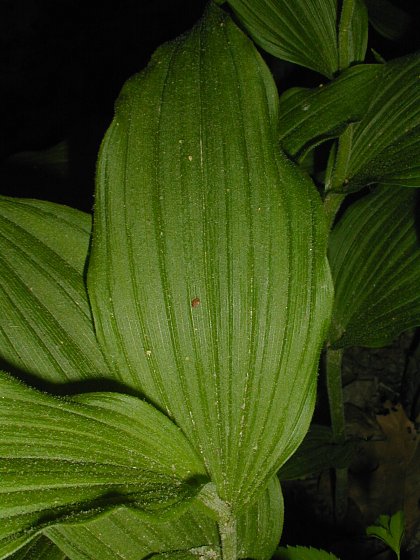
Description: This perennial orchid is 1–2½' tall and usually unbranched. The central stem is round in circumference, rather stout, and densely covered with hair. Three or more leaves alternate along this stem. These leaves are up to 6" long and 4" across; they are oval-ovate to ovate, smooth along their margins, and pubescent. Parallel veins are readily observable along the upper surface of each leaf. The base of each leaf clasps the stem. The color of the foliage can vary from dark green to yellowish green, depending on growing conditions and the maturity of the plant. The central stem terminates in 1 or 2 flowers. Each flower is held above the foliage on a long stalk that has a single leafy bract behind the flower. This bract resembles the leaves, but it is smaller in size and lanceolate in shape. Like other orchids, each flower has 3 petals and 3 sepals. However, because two of these sepals are fused together, there appears to be only 2 sepals.
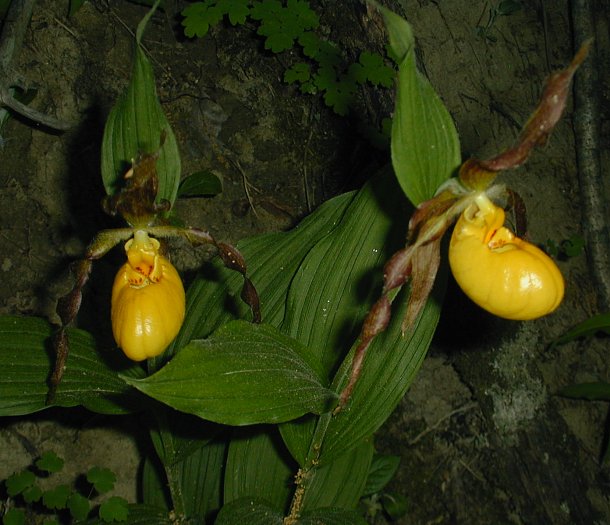
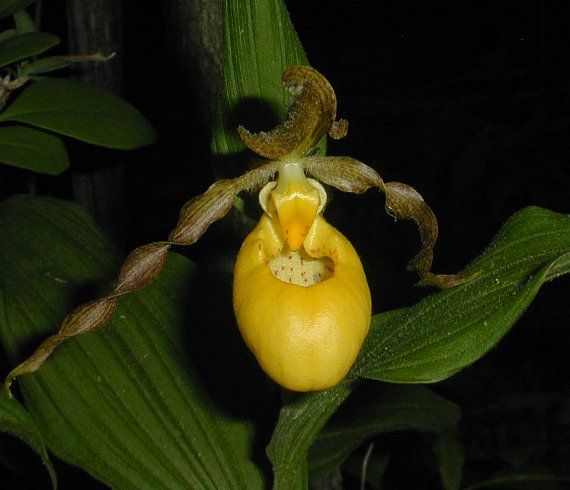
The lower petal is in the shape of a slipper or a pouch with an opening on top; it is bright yellow, shiny, and 1½–2" in length. Within the interior of this petal, there are frequently reddish brown dots. The 2 lateral petals are very narrow, more or less twisted, and 2–3½" in length. These 2 petals vary in color from greenish yellow to brownish purple and they have fine veins running from their bases to their tips. The sepals form an upper hood and a lower hood. They are broader and shorter than the lateral petals, otherwise their appearance is similar. Both the lateral petals and sepals are more or less pubescent. The reproductive organs are located toward the posterior of the slipper-like lower petal. The blooming period occurs from late spring to early summer and lasts about 3 weeks. There is usually no noticeable floral scent. If a flower is successfully pollinated by insects (often this doesn't occur), it will form a seedpod. When this seedpod splits open, the fine seeds are easily carried aloft by the wind. The root system consists of a tuft of fleshy fibrous roots. When several plants occur together, they are often clonal offsets of the mother plant.
Cultivation:
The
preference is partial sun to light shade, moist to slightly dry
conditions, and a soil that consists of loam or sandy loam. Young
plants require the presence of appropriate endomycorrhizal fungi
in the soil in order to flourish. Starting plants from seed is the job
of an expert, although it is possible to successfully transplant large
plants that have been grown in a greenhouse. This is one of the easier
orchids to maintain in a flower garden.
Range & Habitat:
The native Yellow Lady's Slipper is an uncommon plant that is
widely scattered across Illinois (see Distribution
Map).
It is less common than formerly, but still persists
in colonies of variable size
at several sites. Habitats include moist to dry deciduous woodlands,
sandy woodlands and savannas, thinly wooded bluffs along rivers, wooded
slopes, and forested bogs. The size of local populations can increase
in response to fallen trees from windstorms, or occasional wildfires,
as
this reduces excessive shade from woody vegetation. Some authorities
regard this orchid as a native variety of Cypripedium
calceolus, which occurs in Eurasia. Under this system of
classification, its scientific name is Cypripedium calceolus
pubescens.
Faunal
Associations:
The showy flowers attract mostly small bees and various flies. In North
America, Robertson (1929) and Stoutamire (1967) observed
honeybees, little carpenter bees (Ceratina
spp.), mason bees (Osmia
spp.), Halictid bees (Agapostemon
sp., Lasioglossum
spp.), and Andrenid
bees (Andrena spp.)
visiting the flowers. Some of these bees were
regarded as effective at cross-pollination of the flowers, while other
bees became trapped in the flowers and died. Miscellaneous flies
and beetles were also observed to visit the flowers, but they were
regarded as ineffective pollinators. The showy flowers are deceptive
because they induce insects to explore the flowers in the expectation
of a reward, but they contain no nectar and their pollen is unavailable
to them. Two insects have been observed to feed on the Yellow Lady's
Slipper Orchid: adults and larvae of a weevil (Stethobaris ovata)
and larvae of a Scathophagid fly (Parallelomma
vittatum).
Adults of this weevil feed on the shoots, buds, and flowers, while its
larvae feed within the seedpods of this orchid. Larvae of the preceding
fly are leaf-miners. White-tailed Deer readily consume the foliage of
this and
other orchids, and local populations may require a deer-resistant fence
for protection where these animals are abundant.
Photographic
Location: The slope of a wooded
bluff in Vermilion County, Illinois.
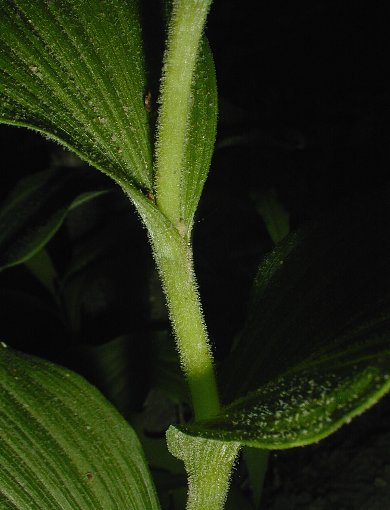
Comments: This is one of the largest and most attractive orchids in Illinois. It is more abundant than most species of orchid, although by no means common. While the flowers are in bloom, it is easy to identify this plant as a Cypripedium sp. (Lady's Slipper Orchid) because of the slipper-like lower petals. The only other species that it can be confused with, Cypripedium parviflorum (Small Yellow Lady's Slipper), has similar flowers that are smaller in size. The lateral petals of its flowers are less than 2" long, while the slipper-like lower petal is about ¾–1¼" in length. The flowers of this species are more likely to be fragrant. The Small Yellow Lady's Slipper usually has a pair of leaves toward the base of the central stem, while Yellow Lady's Slipper usually has 3-5 leaves along the central stem. Some authorities classify the Yellow Lady's Slipper as a variety of the Small Yellow Lady's Slipper, or Cypripedium parviflorum pubescens, rather than a distinct species. Regardless of its classification, when this orchid is not in bloom, it can superficially resemble Polygonatum commutatum (Solomon's Seal) and similar species in the Lily family. However, the central stem of this orchid and the upper surfaces of its leaves are pubescent, while the latter plants have stems and upper leaf surfaces that are waxy and glabrous.