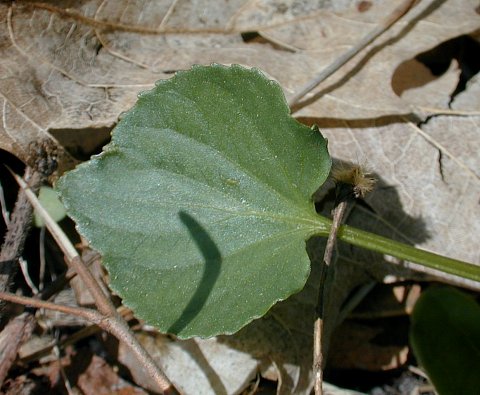
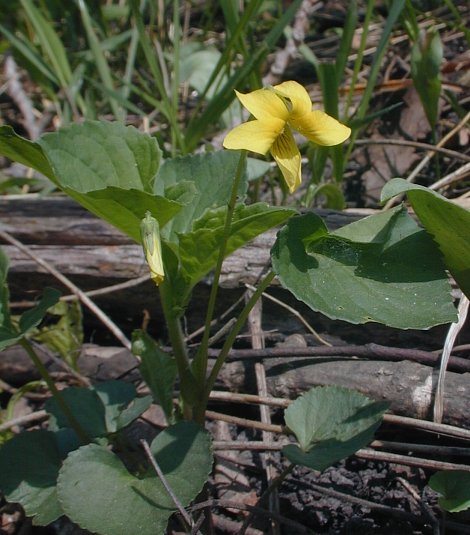
Description: This herbaceous perennial plant consists of a small rosette of basal leaves (usually 3 or more), from which one or more stems up to 1' long may develop. These stems are either hairless or pubescent in longitudinal lines. The blade of each basal leaf is up to 3" long and 2½" across; at its base, there is a stout petiole up to 3" long. The petioles can be hairless or sparingly pubescent. The basal leaves are orbicular-cordate or oval-cordate, crenate-dentate along the margins, and palmately veined. This variety of Viola pubescens has less hairy leaves than the typical variety; the upper surface of each leaf is hairless, while the lower surface is either hairless or sparsely pubescent along the major veins. The cauline leaves alternate along the stems; they are similar to the basal leaves, but smaller in size. There are fairly large stipules where the petioles join the stems; these stipules are lanceolate-ovate. The flowers develop from the axils of cauline leaves; they do not occur on separate stalks from the rootstock.
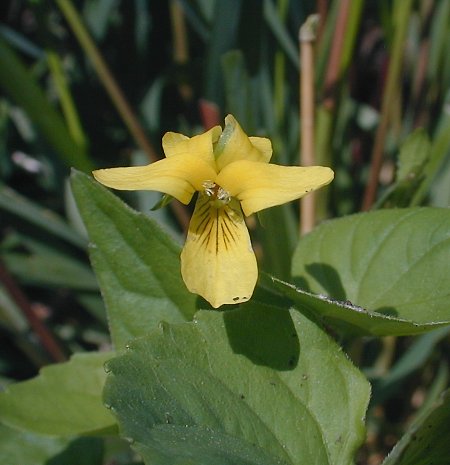
Each flower is
about ¾" across, consisting of 5 rounded yellow petals and 5 light
green sepals. The beardless lower petal has prominent purple veins
toward its base. Each of the 2 lateral petals has a beard at its base
consisting of a small tuft of white hairs; sometimes there are a few
purple veins outside of each beard. The 2 upper petals are beardless
and they usually lack any darker veins. Each flower occurs at the apex
of an individual stalk that is as long as the leaves and their
petioles; this stalk nods
downward at its apex, causing the flower to face outward from the stem.
The floral stalk is either hairless or pubescent in lines along its
length.
The blooming period occurs from mid- to late spring and lasts about a
month. There is no noticeable floral scent. Later, cleistogamous
flowers are produced that lack petals; they can produce fertile seeds
without insect pollination. Fertile flowers are replaced by ovoid
seed capsules about ½-¾" in length. These seed capsules eventually turn
brown and divide into 3 segments; they can eject their seeds up to a
few feet from the
mother plant. The small seeds are globoid and brown. The root system
consists of scaly rhizomes, from which vegetative offsets can develop.
This plant occasionally forms colonies.
Cultivation:
The preference is light shade to partial sun, moist to mesic
conditions, and a rich loamy soil with abundant organic matter. Medium
shade is tolerated later in the year after the trees develop their
leaves. The foliage is little bothered by disease.
Range &
Habitat:
This native violet is common in
nearly all areas of central and northern Illinois; it is slightly less
common in southern Illinois (see Distribution
Map). Habitats include
moist to mesic deciduous woodlands, woodland borders, and thickets.
Unlike Viola pratincola (Common Blue Violet),
Common Yellow Violet (Viola
pubescens eriocarpa) is
not often observed in yards and other disturbed areas.
Faunal Associations:
The nectar and pollen of the flowers attract primarily bees, including
little carpenter bees, mason bees, cuckoo bees (Nomadine), long-horned
bees
(Eucerine), Anthophorine bees, Halictid bees, and Andrenid bees. Less
common insect visitors include Bombylius major
(Giant Bee Fly), small butterflies and skippers, and Syrphid flies.
Syrphid flies feed on pollen and are non-pollinating. The caterpillars
of several Fritillary butterflies and moths feed on the foliage of Violet
spp. (violets). See the Butterfly & Moth Table for a
listing of individual species. The seeds are eaten in limited amounts
by the Slate-Colored Junco and various upland gamebirds, including the
Ruffed Grouse, Bobwhite, Wild Turkey, and Mourning Dove. Both the
Cottontail Rabbit and White-tailed Deer have been known to feed on the
foliage of violets, but this is rather uncommon.
Photographic
Location:
A mesic deciduous woodlands at Busey Woods in Urbana, Illinois.
Comments:
The Common Yellow Violet can be difficult to distinguish from the less
common typical variety, Viola pubescens pubescens
(Downy Yellow Violet). The Downy Yellow Violet is restricted largely to
northern Illinois. It differs from Common Yellow Violet by its hairier
leaves, petioles, and flowering stalks. In addition, Downy
Yellow Violet usually produces only 1-2 basal leaves per plant, rather
than 3 or more. However, in many areas of Illinois, there is a
tendency for these two varieties to intergrade, producing plants with
intermediate characteristics. For this reason, they are no longer
considered separate species by most authorities. This is the only Viola
sp. (violet) in Illinois with yellow flowers, although there
are additional yellow-flowered species of violet occurring in areas
outside of the state.