Description: This herbaceous perennial plant is 1½-3' tall and sparingly branched. The central stem is medium green, terete, and glabrous to slightly hairy, becoming somewhat broader where the bases of leaves wrap around it. On some plants, the central stem has a tendency to zigzag slightly between the alternate leaves. These leaves are up to 12" long, 2" across, and linear-lanceolate or elliptic-lanceolate in shape; they are smooth (entire) and sometimes slightly ciliate along their margins. Because of their length, the leaves have a tendency to arch downward from their bases. The upper leaf surface is dark green and glabrous to short-hairy, while the lower leaf surface is medium green and glabrous to short-pubescent (sometimes there are only minute hairs along the undersides of the veins). Leaf venation is parallel.
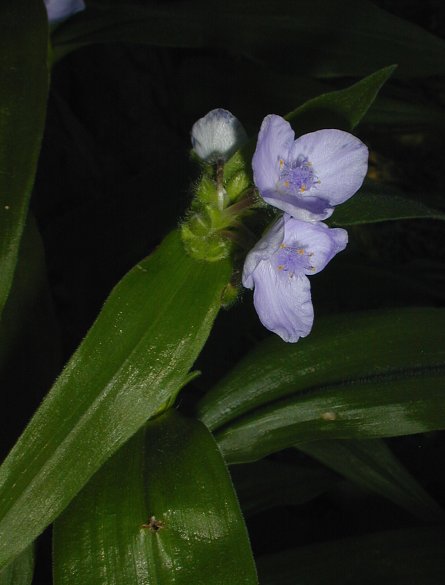
Sometimes secondary stems and leaves develop from the axils of the primary leaves. The central stem terminates in a floppy umbel of flowers on slender pedicels. Sometimes umbels of flowers are produced from the axils of the upper leaves or on short secondary stalks. Each flower is about 1" across when it is fully open, consisting of 3 light violet petals (rarely white), 3 medium green sepals, 6 stamens with yellow anthers, and a pistil with a single style. The petals are oval or broadly ovate, while the smaller sepals are ovate and usually hairy. The filaments of the stamens are pale violet; they are densely covered with spidery hairs. The pedicels of the flowers are about ½" long, medium green or reddish purple, and glabrous to hairy. At the base of each umbel of flowers, there is a leafy bract that is opposite from the alternate leaf; this bract is somewhat smaller in size.

The blooming period occurs during the summer, lasting about 1½ months. The flowers are diurnal, opening up during the morning and closing at about noon (although they may remain open longer on cloudy days). Each flower lasts only a single day. Because only a few flowers are in bloom at the same time, the blooming period is fairly long. Afterwards, the flowers are replaced by 3-chambered seed capsules (up to ¼" long); each of these capsules contain several seeds. The seeds are 2-3 mm. long and flattened-ovoid in shape; they have slightly indented centers, from which several fine grooves radiate outward in all directions toward their outer margins. The root system consists of a mass of fleshy fibrous roots, from which clonal offsets are occasionally produced.

Cultivation:
The
preference is partial sun to medium shade, moist to mesic conditions,
and a fertile loamy soil with decaying organic matter. Like other
spiderworts (Tradescantia spp.), this plant is
little bothered by insect pests and foliar disease. It adapts well to
flower gardens in areas where there is some shade.
Range & Habitat:
The native Zigzag Spiderwort occurs occasionally in the southern half
of Illinois, while it is rare or absent in the northern half of the
state (see Distribution
Map).
Habitats include rich deciduous woodlands, woodland borders, bases of
bluffs, bottoms of large ravines, and shaded areas along streams.
Sometimes this plant can be found in more disturbed areas, such as
shaded areas along railroads, roads, and corners of yards when they are
adjacent to woodlands.

Faunal
Associations:
The flowers are cross-pollinated by bumblebees primarily. Halictid
bees, including green metallic bees, collect pollen from the
flowers, while Syrphid flies feed on pollen. Insects that feed
destructively on Zigzag Spiderwort include the leaf beetles Paratriarius dorsatus,
Oulema collaris,
and other Oulema spp.;
the stink bugs Acrosternum
hilaris, Mormidea
lugens, Proxys
punctulatus, and Euschistus
spp.; and the thrips Frankliniella
fusca. The mucilaginous foliage of spiderworts (Tradescantia spp.)
is eaten occasionally by the Woodland Box Turtle, Cottontail Rabbit,
and White-tailed Deer.
Photographic Location:
Underneath the shade of a tree in a flower garden at Urbana, Illinois.

Comments: Of the several spiderwort species (Tradescantia spp.) in Illinois, Zigzag Spiderwort has the broadest leaves (up to 2" across) and they are typically dark green. Other spiderworts within the state have leaves ¾" across or less. Zigzag Spiderwort is better adapted to shady woodland areas than these other species. Another woodland species, Commelina virginica (Virginia Dayflower), has similar leaves, but the petals of its flowers are blue, rather than light violet, and its lower petal is noticeably smaller in size than the upper two. In contrast, the petals of Spiderworts are the same size. Like plant species in the Lily (Liliaceae) and Iris (Iridaceae) families, both spiderworts and dayflowers (Commelina spp.) are monocots, rather than dicots.